Showing posts with label Math Practices.. Show all posts

Sunday, September 18, 2016

Reengagement Lesson: Modeling our Problem

It's the same every year. I think my sanity is in jeopardy every time I start problem solving the first week of second grade.....and the struggle is real. But within what amounts to just an hour or two in real time, they are making great progress towards getting sensible answers, showing their work on their trays, and being able to talk to their peers about what they are doing and why they are doing it. 

After three sessions of working on our Problem of the Month, I was elegantly reminded that all little kids really need are some good questions, tools, and space. As hectic as it feels, they are actually running it like a boss. Now it was time to get some paper and explain how they got their answers.

Oh boy.

About two-thirds of it was unusable. Of the remaining one-third, I had to really think critically about what my realistic goal was for this first time out. I had a handful of students who wrote out what they did in words; another handful that drew pictures of what they did; and another few who wrote a number sentence AND drew a picture. Of those few, two of them were done correctly, and here's a picture of one of them:
I think this one is so interesting for several reasons. First, the notation is really great. Most students would be thinking about taking away 8 and 5 acorns, which matches the problem situation. But this Little added them...to each other....and then subtracted that subtotal from the 17 acorns Cevanna started with. (If you clicked on the link above, you know that Austin is the child in the problem, but I usually change names to be my students.) As much as I love this one, I had to pass. I needed a straighter path to my teaching point, which I had decided would be:

Mathematicians draw pictures to match their problems, 
and then they write number sentences that match their pictures. 
They do this by thinking about how they started, 
what changed, and how they ended up.  

Writing a teaching point out in this format (Mathematicians do this _______ by doing this______) has been so helpful for keeping me focused on my learning outcomes. I can't recommend it enough. It's the best way I have found to keep me dialed in on the thing I want my kids to take away from this problem to use with their next problems. As you can see, the above recording is clever and thought provoking, but the "what changed" part involves some extra hoop jumping that two-thirds of my class was perhaps not ready to ponder. They will get there, but not if I skip ahead to a more advanced number sentence.

I decided to go with Madai's explanation, because most of my students were relying heavily on pictures.  I wanted to start with a recording that they were already trying to use. Again, most were not very productive drawings, but she is killing it here, and I thank her.

 ("There are 17 acorns. Cevanna gave 8 squirrels an acorn. Then she gave 5 
more acorns away. Now she can feed 4 more squirrels.")

I started this lesson by telling them that mathematicians draw their pictures to match what's happening in the problem. I posed the question, "How do we know Madai is matching her picture to the problem?" With some turn and talk, help from Madai, and just a wee bit of wait time, we were able to articulate that Madai made 17 boxes to be Cevanna's acorn, and then we circled the 8 she crossed out to show she had given them away, then we circled the 5 she had crossed out to show she had given them away. Then we counted what was left. See how focused we are, thanks to our teaching point?  "Mathematicians draw pictures to match what is happening in the problem."

 Next, I showed Ethan's recording. (pictured above) We had some more conversation just trying to interpret what he was doing with his drawing. They asked him if he was showing the acorns and the squirrels. He confirmed he was and then used a pointer to show how his drawing matched the problem. I posed the question, "Madai used crossing out to show what she took away....Ethan hasn't crossed out anything. But he is showing how Cevanna is giving away her acorns.  How do we know what he is giving away, if he isn't crossing any boxes off?" Very fruitful discussion. {LOVE} At the end of the discussion, we repeated that "Mathematicians draw pictures to match their problems, and then they write number sentences that match their pictures" and they agree that it's just exactly what Ethan did.

Finally, I showed them Justine's work, pictured above. (Justine, pronounced Justin #awkwardrollcallfirstdayofschool) Here we noted that he used neither numbers nor crossing off to show what he had done, but we spend a moment counting out and interpreting his groups. I had photocopied (shrunk onto half pages) his work and I gave each child a copy of this picture with the reminder that "Mathematicians draw pictures to match their problems, and then they write number sentences that match their pictures. They do this by thinking about how they started, what changed, and how they ended up."  

I invite them to try to do just that, the way mathematicians do. I used these little sheets as their "tickets out the door" and I was pleased to see that 17 students were able to write the number sentence 17-8-5=4 to match Justine's picture. That means 11 students were not able to write the matching number sentence. I don't plan to address this again in this context, but we now have this anchoring experience that I can refer back to as we move forward trying to record drawings and number sentences for our future problems.

Here are the things we learned from this problem, that we can use in the other problems we do:
1. The most convincing explanations show drawings, number sentences, and words.
2. Your drawing should match what is happening in the story and 
your number sentence should match the drawing and the story.
3. When we write number sentences, we think about how we started, how we changed, 
and how we ended.

(I made this list into an anchor poster, attaching the student recordings we had used to surface these main points. We will refer to it often over the next many weeks and months, and we will add on to it where we need to as we clarify what makes a powerful explanation.)


Tuesday, September 8, 2015

First Problem Solving Workshop

We did our first problem solving workshop (PSW) on the 7th day of school. The first five days were introducing, exploring, and practicing with our tool bags.  Once that was settled, we were able to dive right in....by which I mean oh wait, wait another day because my schedule got rearranged at the last second. Oh, last minute changes, you vex me.

The PSW is my very favorite way to teach math when it comes to operations. The entire thing is based on my understanding of Carpenter/Franke's Children's Mathematics (Cognitively Guided Instruction).  If you teach any workshop, such as reading or writing workshop, you can use the same structure to create space for students to make sense of, and solve, problems.

The workshop structure includes a mini lesson, a work period (which may include a mid-workshop interruption), and a close.  The whole thing takes about 35 minutes - 45 minutes.  Shared below, as our very first PSW of the year, is a mini lesson (introducing a problem together, including reading and acting out) for 15 minutes; a work session for almost 20 minutes including clean up; and finally a quick close on the carpet, less than 5 minutes.

I have been doing this for many years, and I have always started with a "put together" problem. For the first time, I decided, at the last minute (oh, last minute changes, I LOVE you ;) to make the "separate" problem the first one. I am too pleased that I did!

This is all based on Carpenter's work, which I highly recommend that you read, start to finish.  Until then, the main points are 1) children can resolve math story problems without you and your snappy ideas; 2) they do this in totally predictable ways that they construct themselves; and 3) not all math story problems are created equally....some "problem types" are harder for children to access until they have built up a barrel of number sense and an understanding of part-whole relationships.  In reference to #1, if you start with the most accessible problem types, you won't have to do any underlining of key words or circling of numbers or any of that other stuff. And that's because of #2, which includes the information that virtually all students (when we stop pecking at their necks) begin all understanding with a strategy called "direct modeling".

In direct modeling, students will act out, with manipulatives, exactly what the story says, in the order it says it.  So if the math story says "I have 3 cookies. My mom gives me 2 mores cookies. How many cookies do I have now?" a child will read "I have 3 cookies" and place three blocks down. Then the child will read "my mom gives me 2 more cookies" and place two more blocks down.  When they read the question "how many cookies do I have now?" they count all the blocks they put down. (Worried that you have students who can't read this problem? Me too! I won't bore you with the results of my Fontas and Pinnell assessments I just completed, but please know that I have exactly 7 - out of 29 students - that would be considered on "beginning of 2nd grade level"....it's a real thing.)

Which is why, whenever we start a new problem type, we always start with a group reading and acting out of the problem. I like to use names of my students, and their real hobbies, to get us started. In this case, Ishika likes to collect rocks and sea shells, and her class buddy is Jaiyana.

The process is simple: I read it to them from the poster (with blanks....I say "hmmm" for the blank...Ishika has hmmm shells, like that).  We read it all together. I point out that not everyone is reading, so we read it chorally again. Except I have to interrupt us after the first sentence, because not everyone is reading. So we try again. Rinse and repeat UNTIL they GET it that EVERYBODY will participate, full stop. Once we've read it, I have them partner talk about what's happening in this problem. How would they describe what's happening?

This time they shared:  Ishika has shells. (What is she doing with the shells) She's giving shells away. (to whom?) She's giving them to Jaiyana.  (Who is "she" in the last sentence? Is it Ishika or Jaiyana?) It took some discussion, but they decided it was Ishika. Those referent pronouns with second language learners (21 of 29 are, for my class) can be tricky. It's worth talking about.

I gave them the black number pairs first, and taught them to populate the blanks with the numbers, in order. We did 8, 3 first and re-read it chorally as "Ishika has 8 shells. She gives Jaiyana 3 shells. How many shells does she have left?"  Ishika and Jaiyana come up and act it out with cubes. We prove the answer is 5. Then two other people play Ishika and Jaiyana and we did it again for the numbers 7, 2. Two other actors did 9, 3. And a final pair of actors did 11, 2. They would have gone on, but really, it was enough.
As you can see in the picture above, teaching this system of reading the problem with number pairs is extremely helpful as you try to differentiate in your classroom. For the student who finishes in seconds, you can quickly write two more difficult numbers on a post-it and tell them, "These are your new numbers" and they get right to work on it. Likewise, when you come across a Little One who just can't get started, who can't get any traction, you can quickly jot down two smaller, more accessible numbers and say "Try it again with these". Since you taught them how to populate the problem with any two numbers, they are good to go.

When I send them off to the do the problem on their trays with their bag of math tools, I sent them off with the red numbers, 22, 7.  We read it altogether one last time, and then we go to work. Super important: I always send them off with numbers that are just out of their reach....I want it to be a problem they haven't memorized as a basic fact, so that they will rely on the direct modeling intuition to solve the problem. In this case, I also want them to struggle with dealing with the notion of needing to regroup....If they build 22 with two ten-sticks and two units, they are going to be confronting some big math ideas right away. Yummy, I say!

 My job during the work period is to move through the room gathering information, and to do what I call "match making"....finding pairs of students who should talk to each other. It's always the same at first, "Teacher the answer is 9" and that's immediately followed by another breathless student saying "Teacher the answer is 14" at which point somebody will say "No teacher isn't the answer 15?" and I will say, simply, "The three of you need to take your trays to the carpet and explain how you did the problem....do you agree with each other? Is there a way to prove which one of you has the right answer? Do any of you have the right answer?" And so on, until just about everybody is partnered up and discussing the mathematics.
The other job I have is to gather up which strategies they are using. Are there any that should be shared and promoted because they are efficient, flexible, or mathematically important? Are there any that make me want to cry? haha Not even kidding about that one.
This is a really common way of building the 22 in the beginning of second grade. This child is not yet thinking in tens and units, just counting all out by ones.
 This child is also counting all out by ones. The ten sticks are not being thought of as "groups of ten", he is counting each one as "one" and needs 22 of them to make 22. This is less alarming than you might think....lots of students interpret this tool as a "tally mark" almost, rather than as a group of ten. They will make sense of it shortly. In the tray next to him, some enterprising lovely has made 22 as two ten sticks and two units. Thank you, sweet one, this will be very helpful, very soon.

Also very common, is the really long train method of making any number. This is a version of thinking in units, rather than thinking in tens and extras.

That's it! Isn't it lovely? There's no real resolution at the end of these first session, but we have LOTS of information about how our kiddos are making sense of quantity and subtraction, and we have LOTS of great conversations and proof.

At the end of this first session, we clean up and meet back down on the carpet. So much math to share! But I hold it until the next day, when I can craft a sensible mini lesson out of all that math to start our next work session. For today, we close with a quick debrief on the way this works:  We solve our problem, and we get an answer....BUT....we are not "done" until we have talked about what we did with somebody else. Do we understand them? Do they understand us? Are we in agreement? Here is where we can make the point that talking about our math is what let's us test and prove our ideas.  Here is well I will also, gently, suggest that you can talk to each other without first asking me...find somebody to work with, you won't be sorry my Littles!

Monday, October 27, 2014

Practice Puzzles: Math Practice Three

Math Practice One and an explanation of the puzzles
Math Practice Two

There is nothing more charming (and alarming) to me than to listen to a child try to explain themselves mathematically. I truly do love every second of it...I never tire of it, and it never gets old. Having said that, I'm not the only teacher who has to reconcile the balance between pushing past, and lingering in, the nonsense. In all of these Math Practice Puzzles that I am sharing, there is way more to the practice than I have given rise to here in these captured moments. The point was to find ONE thing we could use as an entrance to the practice...I wasn't looking to frontload it in its entirety, I just wanted one shared, contextualized experience to draw out the practice. The rest has unfolded as it has, with some practices more easily expanded on than others. Which feels exactly as it should for working with the Littles. They have Kindergarten until Senior Year to sort it all out. I'm just doing my small part.

So, Practice Three....there are so many deep and important truths in this practice, but the one that we have cleaved to early on is the idea of revision. This practice is tightly wound with other practices, and as we see more patterns, learn more structures, take command of more precise language, and test more solutions and strategies, our communication and explanations will continue to evolve. But these are lofty aspirations indeed, if you consider how we start on this path. There is no primary teacher on the planet who hasn't heard such carefully crafted nuggets as: "I know it's five because that is my favorite number." Or, "I know because I knew it in my head" (which is MOST exciting when it comes with a wrong answer...."8 + 3 =12, because I knew it in my head"). Other oldies but goodies include "I counted on my fingers" and "I guessed".

Early on, I introduced the notion that the onus is on the explainer....if somebody doesn't understand you, it's your job to keep revising your explanation until they do. It's not because they aren't listening to you (they aren't though) and it's not because they aren't smart (they really are) it's because the explanation wasn't sufficient. The correlating piece to this is it doesn't have to be perfect to get started. Focusing on revision means that all you have to do is start. Just say SOMETHING. Then you'll get some feedback, and you can add on/change/delete to make it more clear. Get more feedback. Make more changes. And so on. You don't have to wait until you know exactly what to say or how to perfectly explain something. Just say anything.
From the classroom: Afoa had JUST told us that the two numbers we were going to use to solve our problem were written on the poster, 37 and 43. I turned to Natalia and asked, "So...which numbers do we use?" And she says, I swear, "I don't know." I want to cry haha but instead I tell Afoa, "Well, I'm afraid that explanation wasn't enough for her to understand" and bless his pea-picking-heart he immediately updates it to, "It's the purple numbers on the bottom, 37 and 43." I made SUCH a big deal about this to the whole class! "HOLD UP!! Did everyone SEE what Afoa JUST did???" and then I explained that what he had done was soooooo mathematical because he didn't tell Natalia that she wasn't listening, he didn't tell her oh well you just don't get it, he CHANGED what he said to make it a BETTER explanation." Then Afoa talked about what he had said before and how he changed it. Natalia confirmed that NOW she understands what to do.

Look. It was only marginally mathematical and even calling it an "explanation" is a stretch (it was more like a clarification) but it was all we needed. We have talked about this idea over and over and, in conjunction with a few other key moves, my second graders have made enormous leaps in their ability to explain and question each other. I'm taking it!


Sunday, October 26, 2014

Practice Puzzles: Math Practice Two

Math Practice One and explanation of the puzzles can be found here.
 
Math Practice Two: Reason Abstractly and Quantitatively
This practice is when a mathematician makes sense of the problem in context, then ignores the context to do the calculation, then steps back into the context to make sure the answer makes sense. For example, a child may make sense of the following math story as a combining story:
          "There are 6 kids playing soccer. Some more kids come and now there are 10 kids playing soccer. How many kids came to join the soccer game?"
        In other words, they see this as combining the kids who were playing with the kids who came to join them, and ending up with 10 kids. The model is 6 + ____ = 10. Even though this is additive in context, a child may solve the problem by subtracting 10 - 6 = ____. Once they've made sense of a problem, they can solve it however they want. Then go back and see if it still makes sense.
 I watched my students do this a lot the first few weeks of second grade. They would build the two parts (contextualize) then put them together and count them by 1s, 2s, 5s....however they wanted (decontextualize). They started out building everything as single blocks, and then combined the quantities into one long train. (See the picture above) They were able to go back to the context and tell me the unit, for example that the answer was a number of stickers for this particular problem. But once they made the long train, the original parts were lost to them.

Look, here was the problem: "Diva had 4 stickers. She went to the store and got another 8 stickers. How many stickers does she have now?" So the problem was that they could answer (12 stickers)...but if I then asked, "So how many stickers did she buy?" they would say "12". Because they totally forgot about the parts once the parts were swallowed up into the whole amount that was the sum.

This is problematic because keeping track of those parts is what connects addition to subtraction and it's what is going to allow us to solve subtraction problems as missing-part addition problems (for example, seeing 12 - 8 = _____ and thinking 8 + ___ = 12).

As they got better at thinking about quantities, I started making a VERY big deal about students I saw who were making the parts and color-coding them or counting by 10s and then continuing with the ones without physically moving the cubes to be together, (See picture above) thus maintaining the two parts. When I asked them I would usually say, "Which ones are the stickers she had? Which ones are the stickers she bought?" and when they could answer it was a very good thing. I'd even reserve their trays intact, to use as a mini lesson to start our next workshop....."Friends, do you see what she did??? Like all mathematicians, she arranged this so we could tell which ones were the stickers she bought! Can we answer the question of how many stickers she has now? Of course we can! AND we can still see the two numbers she made....Who remembers what this first number means? What about this second one? And how many all together? Who thinks they can work on keeping their parts like Ariel does? Off you go."

Saturday, October 25, 2014

Practice Puzzles: Math Practice One

 The first few weeks of this school year, I stumbled across a way of introducing and using the Math Practices that really worked for Room 29, so I wanted to share it. I've seen lots of examples of "kid friendly" language for the SMPs (Standards for Math Practice) but this is a little more organic. What I did was, I started our Problem Solving Workshop time on the second day of school. And as my students struggled to make sense of problems, to explain themselves, to model the mathematics and find viable solutions, I just looked for ways that they were already, intuitively, using the SMPs. Little kids are natural mathematicians....never once did I have to tell them how to be mathematical. I just had to open my mind to the possibilities of what each practice might look like.....as performed by a 6 or 7 year old.

Once I had collected all eight (and I'm not going to lie, a couple were a real stretch haha) I used blank puzzles and I drew the incident right on there, labeling it all up. I am nobody's artist, but they are easily impressed and it turns out hairstyle is an easily identifiable attribute among my students. So even though any picture was only marginally akin to the child, everyone totally GOT IT.
 I gave each group of four students a tray with the puzzle pieces for one practice ready to be put together. They had a blast putting it together and then they went NUTS when they realized it was THEM. Oh my gosh! SO GOOD. :D

Once they had the puzzle together, they read it to each other, and made sense of what it was saying. Since they were right there when it happened, and I had made such a big deal out of each one and even repeated it over and over, they had a built-in context for making sense of each one.

Math Practice One : Make sense of a problem and persevere in solving it
            All the kids were on the carpet. I had written a simple “put together” problem on a poster at the front on my easel. “Diva had  _____ stickers. She went to the store and bought another _______ stickers. How many stickers does Diva have now?” In this process, the students have acted out the problem with a variety of numbers I supply them. She had 4 and bought 7. She had 8 and bought 3. She had 12 and bought 4. Different students act out the building of the numbers and combining them. When it comes time to do the problem on their own, I give them bigger numbers they wouldn’t really be able to do in their heads, like she had 17 and she bought 18.
            After giving them the numbers 17, and 18, I ill-advisedly did one more check for understanding. That’s when I asked Janiya what was happening in the problem. After a tense 60 seconds of silence, she slowly said, “Divaaaaa….is….she has…..stickerssssss?” Yes! And how many does she have? Janiya stares off into space. She clearly thinks I will lose interest and ask somebody else. No way, Sister. We are at an impasse, until she absentmindedly swings her head around and looks toward the poster.
            “OH MY GOSH!” I practically yell, “DID EVERYBODY SEE WHAT JANIYA JUST DID????” The other 34 students (you heard me, it was a rough first month) look at me expectantly. That’s how I imagine them, anyway. And I make a VERY big deal out of THIS THING Janiya did….because when Janiya wasn’t sure what number to build, SHE LOOKED BACK AT THE PROBLEM! Isn’t she a good mathematician? That’s what mathematicians do, when they are making sense of a problem, they LOOK BACK TO FIND WHAT NUMBERS TO USE.”
            It was a stretch, but it’s a point we’ve made over and over….’Remember what Janiya did? She did what all mathematicians do….she looked back at the problem when she needed to remember which numbers to build.”


Thursday, August 29, 2013

Dot Talks - The good, the bad, the ugly

I spent all summer telling teachers to start their Number Talks with dots. I mean, I always do, and I have video and photographic proof that it works. My third graders came in 2 to 3 years below grade level (and I'd always joke, "How are they 3 years below grade level? They are in THIRD grade! Did NOTHING happen in three years?" but really...it's not funny) and I swear by dot talks to build their number sense and make things happen from the first day of school.

As a math coach, I did "dot talks" in hundreds of K - 6th grade classrooms. They are a miracle, I swear it!

So it is with great humility that I relate that, on the fourth day of doing dot talks with my new second grade class, I FINALLY did one that worked with this group. Oh. Em. Gee. The first three weren't just bad....they suuuuuuuucked. Big Time.  And it hurts because I think I know where I went wrong.

I'll start at the beginning. I used this dot talk on the first day of school, and it should have worked. I've done it on the first day of school for 1st, 2nd, and 3rd grades.
The general protocol is to show the card with the dot configuration and ask "How many dots do you see?" I show the whole class, then drop the card. (If you hold the card up the whole time, they will just count them, one by one. I want them to rely on parts that they see to put together the total. Counting still happens, but I want them counting the parts they see, not just the whole thing at once.)

When I asked, "How many dots are there?" I got from 4 to 11. Hmmm....should have been my first clue?
When I look at our recording poster, I have to admit, it doesn't look that bad. But it was painful, my friend, I cannot lie. Here, see what I mean?


 Still, no worries, I have had terrible dot talks. I mean, as much as I love them and believe in them, there is no question that they can go very badly. Having a bad first dot talk is not even unusual, as I am fairly rusty after summer and most of the time it's my students' first experience with them also. Surely, they will get the hang of it for day two!

Or.... I can pick easily the most confusing dot configuration on the planet, and then I died.
Do you see how arrogant I was when I chose this configuration? After the pain of the first day, I wanted to use that familiar "5 from a die" shape to get the party started. Then, I quickly tacked on three more dots in a "sideways triangle" type shape. (Please excuse all these technical math terms. ahem.) When I stepped back, I saw what they would do, but I underestimated how painful it would be.

Here you go, in case you don't see it yet. Daveelah's way nets 10 dots, and Alex's way nets 8 dots. All 30 students were nonplussed. It was totally fine with them that these two got two different answers. They both looked right, we understood their explanations, so why not?

No need to panic! I'm a professional. I quickly asked their table groups of 4 to determine how many dots there really are. About three quarters of my class was convinced that it was 8 dots, including Daveelah who offered this explanation:
I was pretty sure they would see that the two dots in the middle were counted once in the blue box and once in the green box. We had just done a venn diagram, so we were on solid ground. Fail.

But don't worry, I got out a bucket of chips and asked them if they wouldn't mind terribly BUILDING this thing we had just done, surely they would see that they couldn't build the first one out of counters unless they had the two middle chips stacked double high. Fail.

In fact, it was so hard to get them to even engage in the ponderings....that I was actually getting frustrated. Not a good way to start your math program. So I let it go (after a very small lecture on what I expect when I ask them a question..."I expect you to think about what is asked...you don't wait for somebody else to think, you dive right in!"), praised dear sweet Abi for her excellent model, and slinked out to recess/yard duty, defeated by dots. We never looked back. As far as I know, they STILL think it's fine that this had "two right answers".  
"Do you see how it matches, mathematicians? Who sees the five part in our dot card? Can you show us where the five part is in Abi's dots? What is the other part? Can we see it in both places? Abi, we understand what you did!"

I have no pictures of the third day dot talk. It was bad. I'm sure you believe me. Here is day four's dot talk though, and it was perfect! A square of four dots, with one dot added on to either end, and we finally got some traction.

Now just like that (*snap my fingers) we are cooking with fire when it comes to our dot talks. I can actually remember why I love them so much. <3

Saturday, August 3, 2013

Math Practice One: Get "UNstuck"

There are 8 Standards for Mathematical Practices in the CCSSM. They are the same for Kindergarteners as they are for 12th graders, as they are for adults and mathematicians. I love the very idea that, in theory, being mathy in kindergarten is essentially the same as being mathy in grad school.

One of the exercises we do is to make sense of the Math Practices in "Kid Friendly" language. It makes sense, right? The first few words of every practice is, "Mathematically proficient students..." so doesn't it make sense that they need to understand the practices? They are the ones who have to do the behavior. They need to own it. Unfortunately, the kid friendly language for this one can sometimes come across as cheerleading...You can do it! Never give up! Always try your hardest!

I mean, yes, these are necessary attributes of the practice. But they aren't the mathematical attributes of the practice. If you look at the details of the practice, we begin to see things like, "They make conjectures about the form and meaning of the solution and plan a solution pathway rather than simply jumping into a solution attempt." Let's be honest...there isn't a teacher alive on the planet who hasn't watched a kid try to add 4+112+2 to solve this problem: "A family of 4 drives 112 miles on 2 tanks of gas. About how many miles did they drive on each tank of gas?"

I just finished a week long summer institute, and it never fails that teachers inspire me to want to be a better teacher. So I started thinking about the things that I do to promote this practice in my students. Let's examine three "get unstuck" strategies from the practice.  Along the way, we'll put them in a more kid-friendly language, think about the classroom experience, and think about out what we can say to students to help push their thinking and behaviors around this practice.

From the practice: consider analogous problems 

Kid Friendly Language: "Can I think of another problem like this one?"

From the classroom: We want students to categorize problem types as they make sense of them. So once they know that "I have 8 stickers and my friend has 7 stickers, how many stickers do we have altogether?" is a problem where we are putting things together, they can begin to think about all the other problems they've done where we put things together, and they can think about and use some of the strategies that they used to solve those problems before.

What I say:  Start open ended...  "Can you think of another problem that we did that is like this one?" Add an optional more focusing question... "Is this problem like the puppy problem? Or is it like the pumpkin problem?"  Or how about a downright leading question... "Is this problem like the puppy problem where we joined them together? Or is it like the pumpkin problem, where we took them away?"

From the practice: They monitor and evaluate their progress and change course if necessary.

Kid Friendly Language: "Can I act it out? Can I try smaller numbers? Can I make a story? Can I draw a picture?"

From the classroom:  Part of persevering is having strategies for getting "unstuck". There is certainly an art to abandoning a current strategy if it isn't working, and knowing how to start on a new, possibly more fruitful, strategy. Kids don't often do this gracefully. They do, however, lick paper, roll on the floor, throw cubes at each other, take out a book, doodle, etc. So when we see students get off track this way in math class, it's a good bet that I'm looking at somebody who is stuck.

What I say: Always start with a question..."Can you show me how you've tried to solve the problem?" My next questions are usually based on what they reveal, but I'll usually refer them to the list of "Can I..." statements to see if there isn't a new way to think about the problem. If a student is just working through pencil/paper strategies and nowhere near a correct interpretation of the problem or accurate answer, it's not unusual for me to give them an answer. "So, if I told you that the answer is 15, could you show me with your blocks why that works?" or "So, if I told you that the answer is 15, could you draw a picture to explain how the problem works?"

From the practice: Mathematically proficient students check their answers to problems using a different method, and they continually ask themselves, “Does this make sense?”

Kid Friendly Language:  "Do I get the same answer if I try it in another way? Can I convince a friend?"

From the classroom: You always have quick finishers, and students tend to over rely on a few strategies, whether they are efficient/accurate...or not. Suggesting that they try another strategy, or hooking them up with a partner who got the same answer to compare strategies, can be a useful differentiation technique. I've also hooked up kids with very different answers to try to convince each other that each is right. Good times, good times.

What I say:  "Andrea, Isaac just got a very different answer than you...can you two get together and see if you can understand what each other did, and come to an agreement on what's happening in this problem?" And when students ask me if they got it right I say, "Well, you've convinced me, but you also need to convince somebody else."

I made this little poster to use with my students. You can get a copy of it by download it for free by clicking Math Practice 1 - FREE (PDF).  Telling students "never give up!" and "keep trying even if it's hard!" does little if we don't also help them develop the tools that get them unstuck.

One final note: Never underestimate the power of the "take a break strategy". George Polya said, "A problem isn't a problem, if it can be solved in 24 hours." The end goal of any one problem solving experience is not necessarily "an answer". It's to develop strategies and mathematical understandings. That's not completed in a 50 minute math lesson. So go home, sleep on it, play soccer, do something else. Fresh eyes are the problem solver's strongest tool at times.


Wednesday, July 31, 2013

10-Frame Flash Cards

Click on the link to download free 10-frame flash cards....read on to find out what they are and why you need them ;)  Set of 10-Frame Flash Cards- Free Download (PDF)
 In John Van de Walle's book, Teaching Student-Centered Mathematics, K-3, he devotes a whole chapter (Chapter Four) to helping children master the basic facts. He writes that Mastery of a basic fact means that a child can give a quick response (in about 3 seconds) without resorting to noneffficient means, such as counting. He doesn't talk about memorizing here, but he does talk about helping students develop efficient strategies based on relationships between quantities (such as anchoring on 5 and 10  to master facts such as 8 + 6 by thinking of 8 as 10 with 2 missing and then getting that 2 from inside the 6 and making a new fact, 10 + 4) and relationships between operations (such as thinking addition to solve subtraction).

There always seems to be some controversy between the "memorize your facts" group and the "develop your number sense" group. But these things aren't mutually exclusive. Memorizing your facts is very helpful. But, developing your number sense is helpful AND important.  In the text series adopted my district, the lessons for subtraction in 2nd and 3rd grade direct students to "think addition" to solve subtraction problems. So for the problem 14 - 8 = ___ students are told, "Since you know that 8 + 6 = 14, then you already know that 14 - 8 = 6."

The only access for students is if they've already memorized 8 + 6 = 14. If they don't have recall of that fact, they have no other strategy for thinking addition to solve 14 - 6. I think this is why people confuse fact memorization as important, instead of just helpful. If it's the only strategy we develop, then it's of the utmost importance!

But think ahead now. Nobody can memorize every fact. I mean, if the child is solving the problem 54 - 28 = ____  is there anybody who thinks it would be reasonable to tell them, "Well, don't you already know that 28 + 26 = 54? " Of course they don't hold this information at a recall level.

But let's go back to the 14 - 8 = ____ problem. If we think addition that 8 + ___ = 14, but haven't memorized that 8 + 6 = 14, I can still derive this fact. I can think about needing 2 more to get to 10; then once I'm at 10, I need 4 more to get to 14. So now I've derived the missing addend as 6, but in a 2 part and a 4 part. Students (people) can do this so efficiently that it can appear memorized.

When students have ample opportunities to develop this strategy of counting up in parts, then they can also use it in the 54 - 28 = _____ problem. If we think addition as 28 + ____ = 54, we need 2 more to get to 30.... 10 and 10 gets us to 40, 50...and 4 more gets us to 54. So the parts we used to count up are 2, 10, 10, and 4, for the answer of 26.

The Common Core Standards are written so that students have both procedural and conceptual understanding. I guess I've heard people say that it's more important to teach procedures first, and worry about the conceptual understandings later. I've also heard people say that you have to develop the conceptual understanding before students can use procedures.  I think everyone must have their reasons for saying so, but in the reality of the classroom, I have found that it happens much more organically than that. You can actually teach the procedures and  concepts in any order or even at the same time. If you are providing a variety of opportunities for students, they tend to take what they need, and cleave to the important ideas, as it makes sense for them.

So here come the flashcards that John Van de Walle suggests.  An old-school flash card has the fact written, such as 9 + 7 and students have to recall 16. But adding the 10-frame quantities to the flashcards help students develop their number sense too. I can SEE now that 9 is 10 with one missing, and I can VISUALIZE moving one dot from the 10-frame with 7 to fill in the ten-frame with 9. Now I'm using the Make a Ten Strategy.


Or now, instead of only having access to 8 + 7 if I memorize the answer as 15, I can now use the 10-frame quantities to see that if I just cover up that last dot on the 10-frame with 8, I've created a 7 + 7, and I only need to add back the covered dot to get the answer 15. Now I'm using the Use a Double (Double + 1) Strategy.

Alright there are your procedures right alongside your conceptual understanding! You really don't have choose. Other ways I've used these cards is to have them sort the cards by which strategy they would use...for which ones would you make a 10? Which ones would you use doubles? Which ones make the most sense just to count up? Which ones do you know "by heart"? Can you explain to a classmate why the strategy you are using makes sense for these numbers? Are there any cards you would use more than one strategy for?

Ohhhhh the possibilities are endless :)


Tuesday, July 30, 2013

More on Math Tools

I get so many questions on how to use math manipulatives when I do professional development on teaching math. I wrote about many of the logistics in this last post, but really, I'm sure I will continue to write about in various forms and contexts. It's that interesting, I promise! ;)

I started out explaining that I present the groups with a tray of a certain tool, and they are given free exploration time. When I was a math coach/specialist for my district, I actually had this process written into the pacing guides. So the first five days of every school year are about introducing tools and procedures, including number talks.
Because I have an abundance of tools (largely scavenged from hallways and supply rooms where they were discarded) I just give everybody the same tools. If I were short of supplies, I would fill each tray with something different and rotate them over the five days. That's still legit for many reasons, actually, but I choose to do it this way because they also learn about the tools by watching each other use them, and talking to each other about what they see happening in different groups.

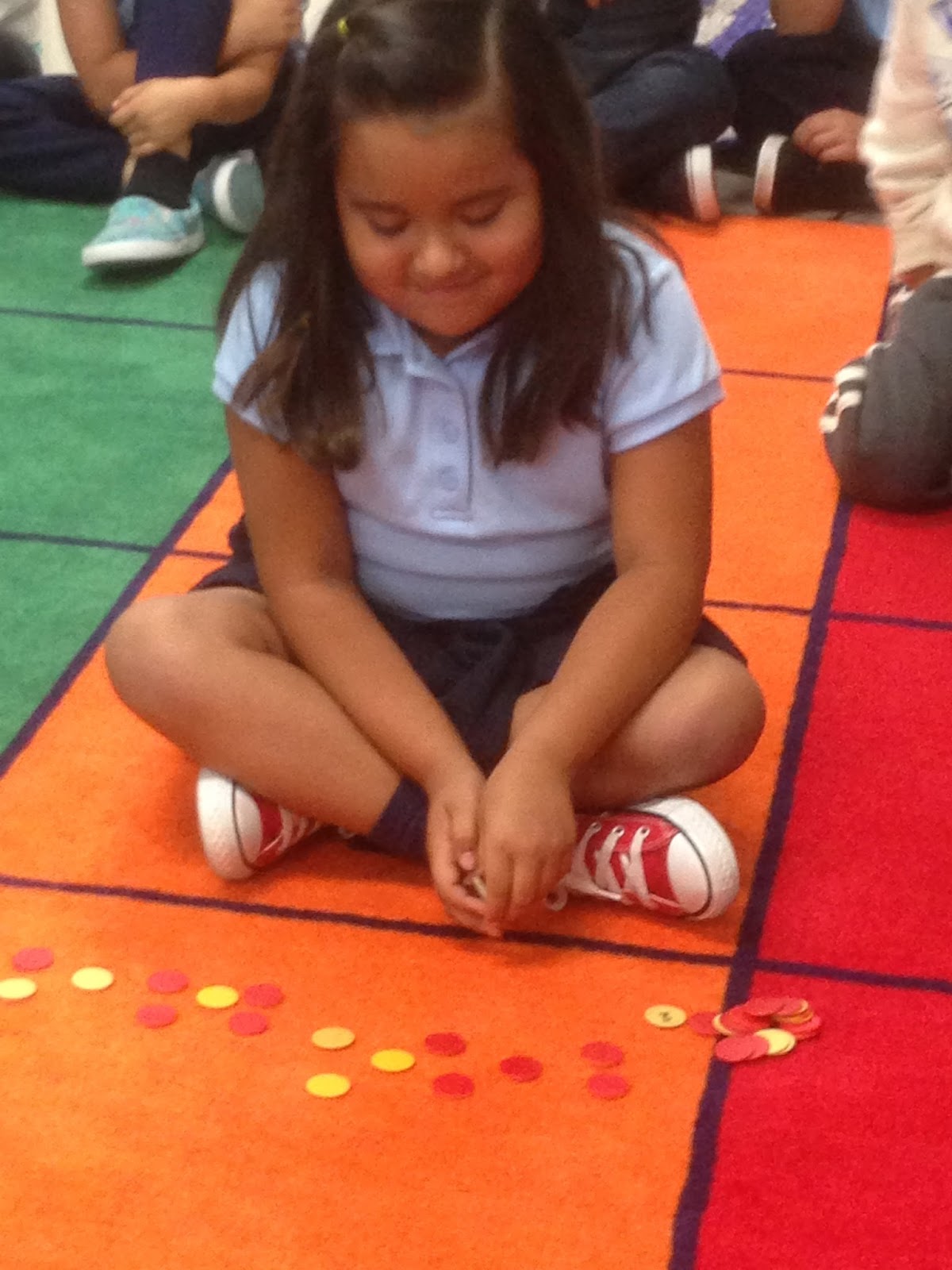
While they are working with the tools, I am circulating and learning a lot. I make notes on conversations I hear, math I see, and procedures I may (will) need to reteach. You can learn a lot about who your kids are in math class by watching them work in free exploration.

Who are your sorters...

Your artists...

Your pattern seekers...

Your hard core playahs...

Your spatial geniuses...

Your future engineers....

and, of course, Your Mopers


 I'm always surprised at how much math surfaces during these play exploration sessions. And if it looks like play? So be it.

Since they have their tool bags (these are last seasons bags, and the new ones are much roomier for the same number of tools), they are in charge of deciding which tools to use, to solve which problems, and in which way. I'm not going to lie to you...the first year I implemented this, and I saw what they did, I thought I'd made a HUGE mistake.

For example? Do you see the 18?
No? Me either. Until he explained: 1, 2, 3, 4 cubes...2 green tiles...1 yellow cube...2 sticks...1 red counter. (4 and 2 and 1 and 2 and 1 is 10). Now look at the dice....one says 3 and one says 5. 10 + 3 + 5 = 18.  This is certainly not what I envisioned!

But we pushed through this part, and it has become easily one of the most powerful, sense-making policies of our math period. It took some time, but we always highlight strategic use of tools. I'll often ask students doing something efficient and/or interesting to tell us a little bit more about why they did it that way. "Why did you use a 10 stick instead of the red counters?" Or, for a problem involving regrouping for subtraction: "I see you used a stack of 10 unifix cubes...how did that help you do the subtraction?"

It also takes offering an invitation to experiment. "What if you used _____? Would you get the same answer?" The more students used the tools as part of their daily practice, and the more invitations I offered to do the same problems using multiple tools, the more the kids made sense of the tools and they began to actually use them strategically. (Standards for Math Practice #5, CCSS)


Monday, July 29, 2013

Using, Storing, and Managing Math Manipulatives

 I am passionate about teaching math, most especially with Littles. I myself love math. A seven year old is a very imprecise tool with which to do math, and can be particularly baffling, for a lover of math. But the thing is, is that the most profound mathematics are introduced and mastered with 5, 6, 7, and 8 year old kids. The number system, relative magnitude, every operation, geometry, relationship and comparisons,  problem solving and logic...it's the same math that underpins algebra, trig, and calculus...it's the same math that underpins engineering, architecture, and balancing your checkbook. It's deep, important, and complex.
Students have access to these tools at any time. They can come here and get a "scoop" of counters or a stick of unifix cubes, anything they think will be helpful...even when I don't believe it will. True story, I bite my tongue a lot.
The new Common Core Standards are, necessarily, imperfect. But if they do nothing else, they elevate the DOING of math to the importance typically reserved in elementary schools for the LEARNING of math. Math so often happens to kids. They are expected to learn math by watching teachers do math. They are often taught discrete rules and procedures in order to get them through arithmetic, without ever developing their sense of being mathematical. When I was a math coach/specialist for my district, it never ceased to amaze me how little cognitive lifting kids were being asked to do in math class. Teachers, pressured to the point of breaking by NCLB (No Child Left Behind, or as we call it, No Teacher Left Standing) requirements, often shied away from problem solving and cleared a path through story problems wide enough to march their whole class across without ever giving kids room and space to struggle and grow mathematically.

I ask myself: would I try to teach reading by never giving a kid a book to read? To me it is the same thing. I can't fathom trying to teach math without giving kids a problem to solve.
 
I moved into a classroom with very little storage this summer, and I invested in these white buckets ($7 with lids at Home Depot) to provide additional math tool storage and seating at our writing center (shown) and reading table.

The eight Standards for Math Practices all start with the words mathematically proficient students to describe how students (people) behave when doing math. The fifth Math Practice is about choosing tools. It's not just about breaking out the base ten blocks to show kids how to make exchanges for the regrouping procedure in subtraction. In fact, research has shown that when teachers decide which tool to use, and how to use it, the students experience the tool as one more set of rules they have to memorize...instead of contributing to the true goal of conceptual understanding.

Making sure my students have access to a variety of tools, as well as promoting a culture of understanding where students are asked (no, required) to pick their own tools and make sense of those tools in a variety of contexts...this is no small undertaking. The pictures above show how I store the math tools.

In the beginning of the year, we spend time introducing the tools. Partly to make sense of them, and partly to outline expectations. We do a "what does it look like and sound like when we are using our math tools" anchor chart.
During the first five days, I put out a tray of different manipulatives each day on each table group. Go to town! We focus on behaviors and procedures for sharing and putting away the tools.
Finally, when they have "met" the tools, the are each assigned a "math bag". Over the years that I have been doing this, it has evolved from a gallon ziplock back stuffed into an already crammed desk to this arrangement, which I'm calling AWESOME. I used a sheet to make 32 drawstring bags. Nothing fancy. Cut rectangles out of the sheets, folded over the top to make a casing for the drawstring ribbon, then folded over the rectangle in half and sewed along the bottom and open side (don't close the top, you have to feed through the ribbon). PRO TIP: once you've run the ribbon through the casing, bring both ends together and tie them into a single knot. You are welcome! ;) These were considerably smaller in past years, I just this summer redid them. Improvements: they are bigger than the last ones, by twice.


 Also improved: I used little 3M tape mounted wall hooks to create a storage area under the whiteboard. It was fun when the bags spilled out of their desks and pieces flew across the floor two to six times a day but, alas, all good things must end. Each bag space is labeled with a student number (1 to 32, I number my students from the time they walk in the door. With a 35% mobility rate, we remain in alphabetical order usually no later than October. By then there's been movement, but when you come in, you just get the last person who moved's number. It means Montse Rivera is going to end up being number 2, ahead of Luis Chavez, but pay that no mind. Number order please!)


 The labels on the bag space now match the numbers I put on each bag. I used puffy fabric paint that comes in a tube and I freehanded the numbers. Because I'm a gangster like that. haha

Students use these bags during the math time. If they need more or different tools than what are in the bags, they can get it from the bins or buckets. Like Crystal here, who was counting out 60 pencils for her story problem...by counting each 10-stick as one pencil...at the beginning of third grade. Ayyyyy....my aching head.

 When Crystal told me she needed more ten sticks, what I thought was, "No you don't. You need 6 of them." What I said was, "Sure, they are over there." And then I made a mental note that half my class was just like her, and I had some place value work to do. Ahem.

In my second grade class, each math bag has: 40 ten sticks, 25 unit cubes, 25 red and yellow counters, 40 unifix cubes, 40 square tiles, and a die (for centers and games). I'm pretty sure it's exactly the same thing they had in third grade last year...maybe they had 60 square tiles.

Also available in the bins and buckets: more of all those, plus hundreds flats, thousands cubes, cuisenaire rods, fraction pieces (strips and circles), atrribute blocks, centimeter and inch cubes, plastic coins, and pattern blocks.

Available at all times in baskets around the room: rulers, measuring tapes, protractors, ten frames, and balance scales.

It's a process. We go back to review/reteach how to store and take care of our manipulatives regularly. But of all the things I've done in the last years as a teacher to open up the world of mathematics to my students, this is up at the top. So worth the aggravations and inconveniences!