Showing posts with label Common Core Math. Show all posts

Thursday, September 10, 2015

Second Problem Solving Workshop

Last Thursday was the first session (described here), and last Friday (the 8th day of school) we did the same problem with new numbers.  After doing 22-7, I noticed that most kids could get an answer, but there was very little understanding of place value (as tens and ones) and regrouping (in order to get more ones from a ten). Totally normal in the beginning of second grade, from my experience.

The workshop period follows the same structure of writing or reading workshop:  a mini lesson (10-15 minutes), a work period (115-20 minutes), and a close (5-7 minutes).  In this case, I wanted to address the way we build "bigger numbers", tool choices, and then sharing one strategy that a student had for regrouping. Then I would send them off to work on the exact same problem with even more complex numbers.

On the first day, I had seen many ways to make 22, but I didn't want to encourage all of them. There were ones I didn't love....here's one:
He was using the ten sticks like units, or tally marks, and needed 22 of them to make 22. It's not unusual, and he will figure this out (as of today, the 11th day of school, he was still doing this). I'm not sweating this (yet, haha) but I'm not offering it to other students, either.

So here's my mini lesson, to open up day two of our Problem Solving Workshop. I drew out the first tall train of 22 cubes, and the second 2 ten sticks with two extras way.  The last one, with two ten-cube trains and two extras, was added during the lesson, as were the marks cutting across the first tall train way.

I began by saying I saw lots of ways that people made 22...I said, I saw Mehdi make this tall train. (Added his name.)  When I asked if anybody else made it this way, we got lots of "me too" hand motions. I told them we would have to count them, to test his train, which we did chorally. When we verified that it was 22, I wrote it under the train. 

I went on to say that I saw some people making it this way, like Angel did. (Added his name.)  This also got lots of "me too" hand motions. (For "me too" we just do a thumb pointing to our chest, pinky stuck out in front of us, almost like a "hang ten" but pointing - often frantically - back at ourselves.) We counted it as 10-20-21-22, labeling as we went along and writing it under the train once we had verified it.

Now, my goal, always, is to get them talking and listening to each other. But it's with a nod to my sanity that I do a bit more of the heavy lifting in this area at the beginning of second grade than I am totally comfortable with. I can't tell you how many times I've started a lesson with "Jasmine did the most interesting thing yesterday, Jasmine, go ahead....tell us what you did" as a way of jogging her memory and handing off the discussion to a student, only to have the student launch into a totally unrelated, inconsequential account that usually starts with something like, "oh, first, I took all my blue cubes" (no you didn't) "and then I put 2 and 5 and 3 and then I..." (no you didn't) "I thought about what I should do and then I remembered that I had some red cubes" (no you didn't)..... enough already, let me handle this.

So Jasmine had built her 22 like this:
She had originally built it with the two ten sticks and the two extra cubes, but when I came back, she had built the second way, with the two trains of ten cubes and the two extra cubes.  When I asked her about this, she showed me how she took away the two, but then couldn't break the sticks:
Haha here she is trying to snap off a couple. So cute. During the mini lesson, I asked her to show us how she tried to snap some off, and at this point, I was able to say, can you now show us the NEW way you made the number 22? And she was good to know, she knew exactly what I was talking about and there we went.

So far, in the 10 minute lesson, we had addressed building the quantity three different ways, and we had shared a strategy for regrouping by using the cube trains rather than the base 10 ten sticks to build the number. (Notice that she didn't just regroup one ten, she redid ALL the tens. In direct instruction, we would no doubt instruct her to regroup one ten...virtually every second and third grader I've ever met does it the same way as Jasmine, before they make sense of just swapping out one.)

To close the mini lesson, we went back to Mehdi long train and I asked them to partner talk about if Mehdi's way was the same or different as Jasmine's way.  After we discussed it, I posed the question:  Can we make Mehdi's look like Jasmine's? Are there ten-trains inside this long train? (The said yes, there are)  How many do you think we can get? (two) Let's try. (We counted up to ten, marked it off, counted up to ten, marked off....and saw the two extras, just like Jasmine's. I invited them to think and build their numbers using "TENS" and gave them their new numbers.
We did the same problem and I gave them the numbers on the yellow post it note (34, 18). We read the problem together as "Ishika has 34 shells. She gives Jaiyana 18 shells. How many shells does she have left?"
 
And here's Mehdi....he moved immediately from the long train to the ten-cube trains to make 34.  Proving, once again, that sometimes a kid hears the exact next idea they needed to hear, and that's all they will need to move forward.

 And here's Bryan and Ahmillyion making tall towers. Proving, once again, that when a kid is not ready to hear it, they will take a great idea....and do absolutely nothing with it.  No big deal, I will be inviting them to think in tens for the next few months.  They will get there!

During this work session, Angel continued to build his numbers with base 10 ten sticks and single unifix cubes.  When I asked about how he was giving away 18 shells, he showed me how he gave away as many as he could, then he used his finger to count down the markings on the permanent ten stick. He held his finger over the counted off section and said, "If I could take this off, I would." I told him about Brandon, a third grade student I had many years ago, who had this same idea and he discovered that he could mark them off with an expo marker. We got one, and I showed him how it would be fine, that it rubs right off, and he went right to work.


Here he has crossed out all of one ten with a straight line, then x-ed out 8 more from the other permanent sticks. He counted the remaining cubes as 1-2-3-4-5-6 and 10 more is 16.

Lovely!  Now we have successfully concluded our SECOND problem solving workshop. Students are making sense of a simple give away problem in context, and we now have several ideas for building bigger numbers with tens, and two ideas for regrouping (marking off, or swapping out) when we don't have enough ones to give away.  I will point out, that there is no way I could give my second graders a worksheet with problems like 34-18 or even 22-7 during the first week of school. It is only because they are using this "direct model" method that they are able to do the math, while simultaneously making sense of place value, and developing their understanding of the attributes and functionality of the different tools.

The close on this second day was straightforward:  I saved Angel's idea for the opening of the next session, and we cleaned up and reconvened on the carpet to recollect what a responsible classroom sounds like and looks like when it is time to clean up. Hint: there is no yelling, running, or swinging math bags over our heads. *ahem*

Tuesday, September 8, 2015

First Problem Solving Workshop

We did our first problem solving workshop (PSW) on the 7th day of school. The first five days were introducing, exploring, and practicing with our tool bags.  Once that was settled, we were able to dive right in....by which I mean oh wait, wait another day because my schedule got rearranged at the last second. Oh, last minute changes, you vex me.

The PSW is my very favorite way to teach math when it comes to operations. The entire thing is based on my understanding of Carpenter/Franke's Children's Mathematics (Cognitively Guided Instruction).  If you teach any workshop, such as reading or writing workshop, you can use the same structure to create space for students to make sense of, and solve, problems.

The workshop structure includes a mini lesson, a work period (which may include a mid-workshop interruption), and a close.  The whole thing takes about 35 minutes - 45 minutes.  Shared below, as our very first PSW of the year, is a mini lesson (introducing a problem together, including reading and acting out) for 15 minutes; a work session for almost 20 minutes including clean up; and finally a quick close on the carpet, less than 5 minutes.

I have been doing this for many years, and I have always started with a "put together" problem. For the first time, I decided, at the last minute (oh, last minute changes, I LOVE you ;) to make the "separate" problem the first one. I am too pleased that I did!

This is all based on Carpenter's work, which I highly recommend that you read, start to finish.  Until then, the main points are 1) children can resolve math story problems without you and your snappy ideas; 2) they do this in totally predictable ways that they construct themselves; and 3) not all math story problems are created equally....some "problem types" are harder for children to access until they have built up a barrel of number sense and an understanding of part-whole relationships.  In reference to #1, if you start with the most accessible problem types, you won't have to do any underlining of key words or circling of numbers or any of that other stuff. And that's because of #2, which includes the information that virtually all students (when we stop pecking at their necks) begin all understanding with a strategy called "direct modeling".

In direct modeling, students will act out, with manipulatives, exactly what the story says, in the order it says it.  So if the math story says "I have 3 cookies. My mom gives me 2 mores cookies. How many cookies do I have now?" a child will read "I have 3 cookies" and place three blocks down. Then the child will read "my mom gives me 2 more cookies" and place two more blocks down.  When they read the question "how many cookies do I have now?" they count all the blocks they put down. (Worried that you have students who can't read this problem? Me too! I won't bore you with the results of my Fontas and Pinnell assessments I just completed, but please know that I have exactly 7 - out of 29 students - that would be considered on "beginning of 2nd grade level"....it's a real thing.)

Which is why, whenever we start a new problem type, we always start with a group reading and acting out of the problem. I like to use names of my students, and their real hobbies, to get us started. In this case, Ishika likes to collect rocks and sea shells, and her class buddy is Jaiyana.

The process is simple: I read it to them from the poster (with blanks....I say "hmmm" for the blank...Ishika has hmmm shells, like that).  We read it all together. I point out that not everyone is reading, so we read it chorally again. Except I have to interrupt us after the first sentence, because not everyone is reading. So we try again. Rinse and repeat UNTIL they GET it that EVERYBODY will participate, full stop. Once we've read it, I have them partner talk about what's happening in this problem. How would they describe what's happening?

This time they shared:  Ishika has shells. (What is she doing with the shells) She's giving shells away. (to whom?) She's giving them to Jaiyana.  (Who is "she" in the last sentence? Is it Ishika or Jaiyana?) It took some discussion, but they decided it was Ishika. Those referent pronouns with second language learners (21 of 29 are, for my class) can be tricky. It's worth talking about.

I gave them the black number pairs first, and taught them to populate the blanks with the numbers, in order. We did 8, 3 first and re-read it chorally as "Ishika has 8 shells. She gives Jaiyana 3 shells. How many shells does she have left?"  Ishika and Jaiyana come up and act it out with cubes. We prove the answer is 5. Then two other people play Ishika and Jaiyana and we did it again for the numbers 7, 2. Two other actors did 9, 3. And a final pair of actors did 11, 2. They would have gone on, but really, it was enough.
As you can see in the picture above, teaching this system of reading the problem with number pairs is extremely helpful as you try to differentiate in your classroom. For the student who finishes in seconds, you can quickly write two more difficult numbers on a post-it and tell them, "These are your new numbers" and they get right to work on it. Likewise, when you come across a Little One who just can't get started, who can't get any traction, you can quickly jot down two smaller, more accessible numbers and say "Try it again with these". Since you taught them how to populate the problem with any two numbers, they are good to go.

When I send them off to the do the problem on their trays with their bag of math tools, I sent them off with the red numbers, 22, 7.  We read it altogether one last time, and then we go to work. Super important: I always send them off with numbers that are just out of their reach....I want it to be a problem they haven't memorized as a basic fact, so that they will rely on the direct modeling intuition to solve the problem. In this case, I also want them to struggle with dealing with the notion of needing to regroup....If they build 22 with two ten-sticks and two units, they are going to be confronting some big math ideas right away. Yummy, I say!

 My job during the work period is to move through the room gathering information, and to do what I call "match making"....finding pairs of students who should talk to each other. It's always the same at first, "Teacher the answer is 9" and that's immediately followed by another breathless student saying "Teacher the answer is 14" at which point somebody will say "No teacher isn't the answer 15?" and I will say, simply, "The three of you need to take your trays to the carpet and explain how you did the problem....do you agree with each other? Is there a way to prove which one of you has the right answer? Do any of you have the right answer?" And so on, until just about everybody is partnered up and discussing the mathematics.
The other job I have is to gather up which strategies they are using. Are there any that should be shared and promoted because they are efficient, flexible, or mathematically important? Are there any that make me want to cry? haha Not even kidding about that one.
This is a really common way of building the 22 in the beginning of second grade. This child is not yet thinking in tens and units, just counting all out by ones.
 This child is also counting all out by ones. The ten sticks are not being thought of as "groups of ten", he is counting each one as "one" and needs 22 of them to make 22. This is less alarming than you might think....lots of students interpret this tool as a "tally mark" almost, rather than as a group of ten. They will make sense of it shortly. In the tray next to him, some enterprising lovely has made 22 as two ten sticks and two units. Thank you, sweet one, this will be very helpful, very soon.

Also very common, is the really long train method of making any number. This is a version of thinking in units, rather than thinking in tens and extras.

That's it! Isn't it lovely? There's no real resolution at the end of these first session, but we have LOTS of information about how our kiddos are making sense of quantity and subtraction, and we have LOTS of great conversations and proof.

At the end of this first session, we clean up and meet back down on the carpet. So much math to share! But I hold it until the next day, when I can craft a sensible mini lesson out of all that math to start our next work session. For today, we close with a quick debrief on the way this works:  We solve our problem, and we get an answer....BUT....we are not "done" until we have talked about what we did with somebody else. Do we understand them? Do they understand us? Are we in agreement? Here is where we can make the point that talking about our math is what let's us test and prove our ideas.  Here is well I will also, gently, suggest that you can talk to each other without first asking me...find somebody to work with, you won't be sorry my Littles!

Sunday, September 6, 2015

First Week of Math - Exploring Tools

Over the first 5 days of school, we introduce, explore, and divvy up a set of math tools that the students will use during problem solving workshop for the whole year.  It starts on the first day of school. I start number talks on the second day of school, and it's always a "dot talk". This means that I need them to play with dots to exhaustion on the first day of school so I can protect my sanity when they need to use the dots on day two.

The first step is to lay down some ground rules. I'm not going to lie...this is a loud, sometimes crazy and explosive process.  My philosophy here has always been, "It's exciting to get an idea and test it!" As far as the students are concerned, they are pioneers!  Nobody has EVER thought to make a train of cubes that goes around the ENTIRE carpet before (everybody has thought of this haha but they don't know it) and thinking of this then doing this can be very exciting...which requires some hopping...and shouting.  I do try to minimize this, but I also ignore a lot of it during this free exploration period.

Before we start, we brainstorm what it "looks like" and what it "sounds like" when we are being responsible with the math tools. (They don't go in our mouths, up our noses, no throwing, we share, we ask if you are done with those before we grab them, etc.)  After we finish, we reconvene on the carpet and go over how we did....did it "look and sound" like the important and serious work that it is?  Here is where I will remind them that we should be using "level 2" voices, which is a normal voice, but not an outdoor voice.

Finally, before we walk through this, may I suggest a "shout out" call to attention?  Bells, chimes, sing songs....I do it all, as one must if you are serious about having their attention when it matters, but I have to admit, nothing beats a call and response shouting when the noise level creeps up.  For the last five or six years I've been (literally) yelling "yo yo yo!" and they (literally) yell back "yo what's up!" then everybody freezes and we have a window of opportunity to make an announcement, call for civility, and/or transition out of exploration.

We follow the same process every day. Set out a tray of one type of tool for each table group. Go! I walk around saying "yes" as often as possible. "Teacher, can I make the world's longest train?" Yes you may. "Teacher, can we work on the carpet?" Yes you may. "Teacher, can we have more red ones?" Yes you may. "Teacher, can I make a tower?" Yes you may. "Teacher, it got too tall, can I stand on a chair?" Yes you may. (Let me just stand here next to you though, how about that?) I also carry a clip board with this little checklist of observable behaviors, made by my dear friend and teacher extraordinaire Kristy. It helps me focus on the math that is happening amid the chaos, and it also lends an air of officiousness that is sorely lacking without it.

At the end of each work session, as a new tool is cleaned up and put to bed, each student gets their math bag (students are assigned a number that goes with their name - "a" kids start with number one and end with "z" kids at *cough* 32 when I'm lucky) from the hook and counts out a number of the tool to add to their bag.

(The tool bags started as gallon ziplocks, but I eventually repurposed a few cheap sheets and maxed out my sewing skills by make three straight lines for the seaming and one hem for the drawstring. The dimensions are still roughly those of a ziplock gallon storage bag, though taller....13" tall by 11" wide, give or take, finished dimensions.) (ETA:  Each bag has a number written on it in fabric paint, which matches the numbers assigned to the students, which matches a number on the wall behind the bag, not yet affixed in this picture.)
 At the end of this period, each student puts 25 red/yellow counters in their bag.
 At the end of this session, they add 40 unifix cubes to each bag.

 
 At the end of this session, they add 40 ten sticks (not 4, worth 40, but 40 actual sticks) and 25 units.
 At the end of this session each child adds 60 flat square tiles to their bag.

Other things that will no doubt likely end up in their bags include an expo marker, a die, and some hundreds flats.  In the picture below, you can see that MORE of each of these tools is available in this open storage. As we begin to solve problems using our tools, we may find ourselves in need of more of one thing or another, and we can always come here and get them. That basket of hundreds flats is always available too, but doesn't usually gain popularity for some time.

  On the fifth day, we don't introduce a new tool, but we practice taking our bags out, using the trays (seen above stacked up on the side) and practicing using our tools in whatever way we choose, but focusing on keeping OUR tools on OUR tray. After cleaning up and putting everything away, we also introduce the "I Found This!" bucket, seen on top of the stack of trays below. When we find ANY math pieces, at ANY time, on the floor, kicked under furniture, inside our pencil boxes, any old where at all.....we put it in the "I Found This!" bucket (named thusly by the number of students who walk up to me and say "Teacher I found this").  Make sure you are clear....no puzzle pieces, crayons, broken pencils, hair (!) goes into this bucket. Only math pieces! At the end of each week, it's somebody's job to sort everything back into those open buckets.

I used to spend time, every summer, counting out the tools for each child. Sometimes, I even had them in little plastic snack bags INSIDE the math tool bags. But then, to be honest, I was wayyyyy too invested. I needed to just divest from the entire process. When I tell them to count out 40 or 60 of something, in all likelihood, some number of kids will miscount. Don't care. Some number of kids will eventually find that their bags are empty and/or a certain tool is totally not accounted for. Don't care. That's what the open storage is for, go get some more of whatever you need.  But as you can see, by the end of the year clean up photo below, somehow it all ends up back with me. It's a zero-sum game from my perspective....they go out, they all end up back. What happens in between, I had to tap out. I have enough crazy to manage without adding "what's in your tool bag" to the list.

I'm including this as your end of the year clean up tip, even though I'm assuming you are MUCH smarter than I am. This system works...Each table group gets a small bucket for each tool type. They sort their own bags into those buckets. Those buckets get dumped into the five (10?) gallon paint buckets we use for chairs at our reading table and writing centers. Kids who get done early can start making ten trains out of the cubes, since they store better that way.  Every couple of years we take buckets of tools out to the playground and add a bit of dish soap and water. When they ask why we are cleaning the tools, I tell them it's because they like shiny things. They agree, and we carry on. Love second grade :)

Here are the kids the first year I taught second grade, when we dumped ALL our bags on the carpet at the end of the year and tried to sort them into the buckets from there. It took four days, and they had lost interest long before any serious headway had been made.
 And here's me, on day two of four.  Just saying.


Thursday, January 9, 2014

Buddy Classroom - Math

My friend and colleague is a Kindergarten teacher at my school. Although we have a ridiculous mobility rate (to wit: two students still haven't returned from their yearly trip to Mexico; one student who just came here from Egypt - Egypt! - in October is now leaving because her family found a place to live in a neighboring district; and I have a new student starting Monday from the Philippines. And that's just this week!), there is still a good chunk of my students who had her for Kindergarten the year before last. And a handful have siblings in her class right now.

A couple of months ago, we wrote them a big poster letter:
 "Dear Room 1, There are 2 ducks in the pond. Then 3 ducks came to the pond. We want to give every duck 2 peanuts.  How many peanuts do we need? We need your help! Please! Please! Please help us solve this problem! Love, Room 29

My students delivered the poster to their former teacher, and her students solved the problem by acting it out. She video taped the entire activity, from them making sense of the problem, to figuring out who should be a duck in the pond, to what should they use for "peanuts", to counting (correctly, then incorrectly, then correctly) the number of peanuts they needed to solve the problem. 

She sent the video back to me. And then I died. It is 9 minutes and 48 seconds of YES. I laughed the whole time I watched it, and I still do. It's just too good. It's hard to pick a favorite part, but watching them decide what to use as "peanuts" has got to be up there.

Teacher: Okay, so we have our ducks in the pond, what do they need now?
Them: More water! 
Teacher: Let's read the story again (reads it to them) What do they need?
Them: Peanuts!
Teacher: But we don't have any peanuts, what can we use instead?
Montrell: How about peanuts?
Teacher: But we don't have any peanuts, is there something we can use to pretend?
Elmer: We could use popcorn!
Teacher: Well, let's look at the problem, is it popcorn or peanuts?
Them: PEANUTS!!!
Teacher: Right, but we don't have any peanuts...is there something else we can use? ....maybe something in this classroom that we can pretend is a peanut?....maybe some math manipulative that could be a peanut?
Girl: How about those blocks?
Teacher: (sweating) Ok! So show us what that would look like....

Here are my students watching the video of her kids solving the problem. Along with the video, they sent a poster letter back asking us a math question too. Their question was "How do you make five?" Haha! I love them!


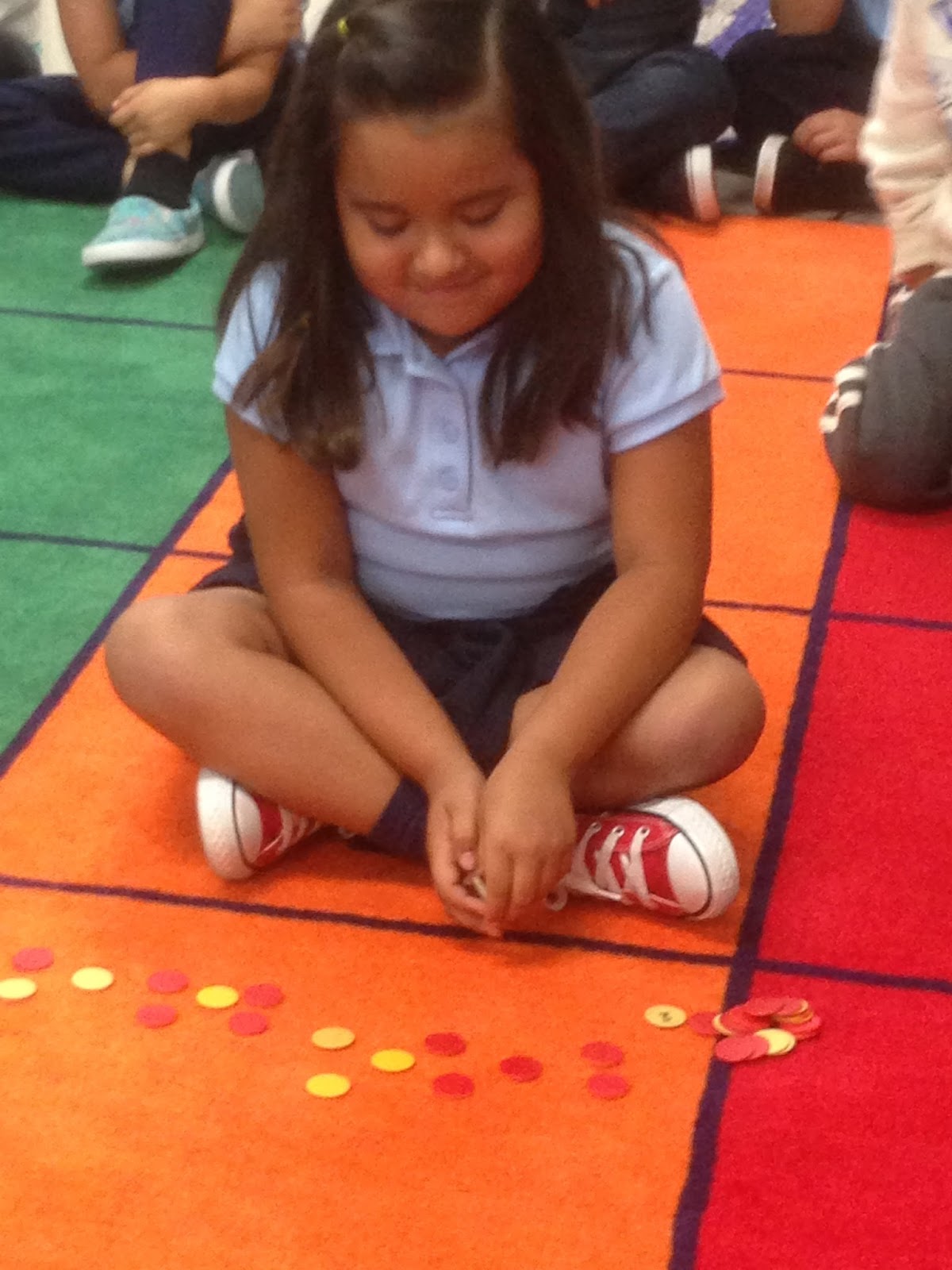
At first, both the Kinder teacher and I worried that it wasn't problematic enough for my 2nd graders, but it turned out it was a great question for them. We played a game of "Shake and Spill" using cups of 5 yellow/red counters. The game and the recording of how the counters landed wasn't terribly difficult for them (but it was exceedingly fun!) so our problem solving experience focused on how they could prove that they had ALL the ways, and this included making sense of the commutative property (is 2 yellows + 3 reds the same as 3 reds and 2 yellows?). They made a poster of their findings, and we sent it back to Kindergarten with a video of us playing the game and proving we have all the ways.

We are loving this way of doing Buddy Math! All of our students are working on the things that are grade level appropriate, and that are truly problematic for them, but they are still experiencing the excitement of working together through the letters and the videos.

{LOVE}

Tuesday, January 7, 2014

Matching Cards

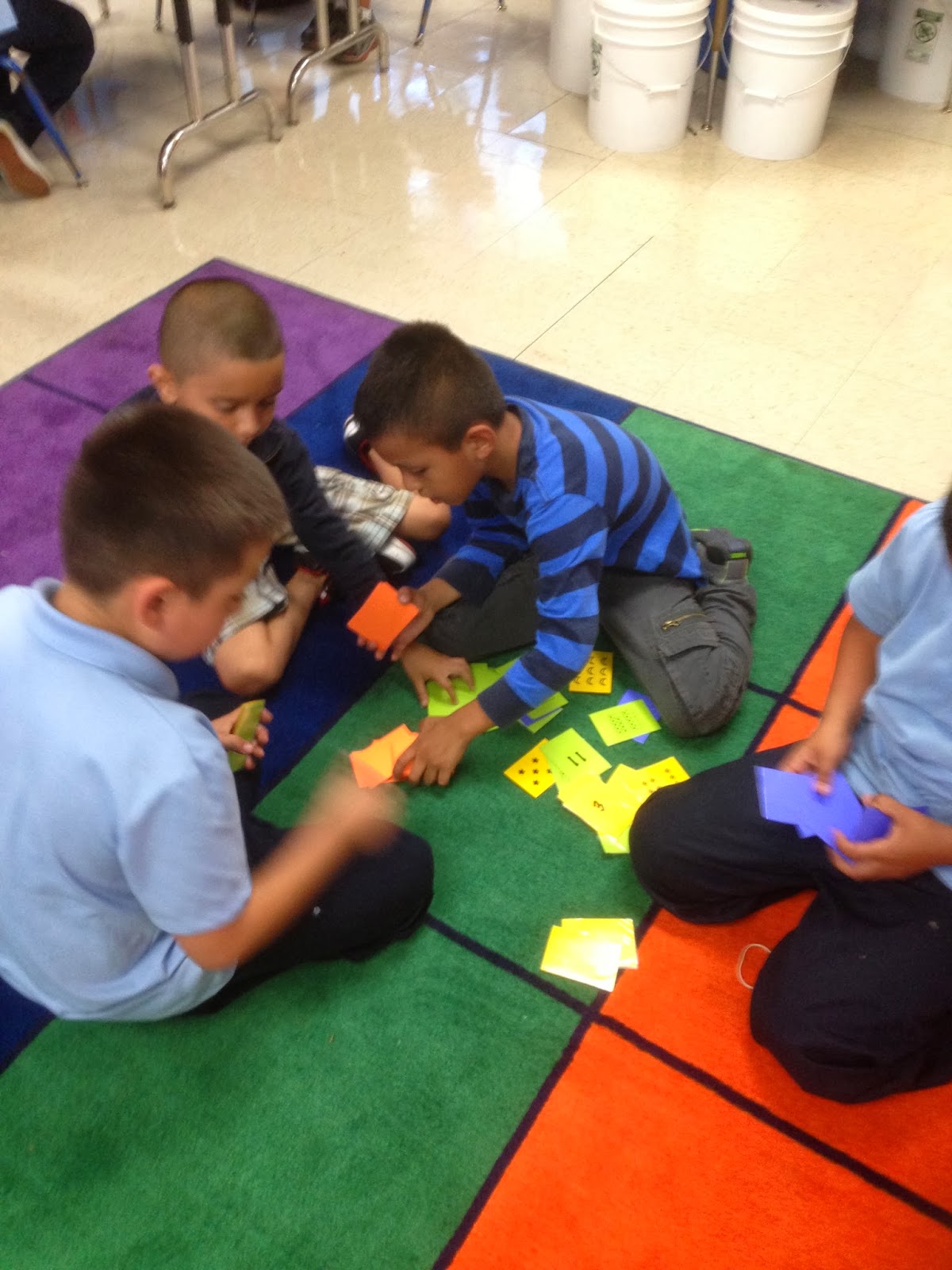
I made these matching cards right around the time school started, and I kinda love them. If you love them too, you can download the pdf files from my google drive. I use all the sets with my second graders. I just photocopied each set onto a different color of cardstock, and they keep the whole stack in their shared materials buckets in their table groups.

If they finish their journal and calendar work before their classmates, they can pull out the cards and play "concentration" style to match the cards.
 They can play alone...


Or with a partner or small group.

They love these cards as much as I do! They are always available, and I have to admit, they have saved my bacon more than once completely outside of our math block. Nothing like a no-prep no-fuss activity that can be used anytime they have a few minutes to spare.

Me: Why are you running with a broom?
Them: I'm done!
Me: Put that down and get out your math cards. Please.
*ahem*

Because we want our students to use the standards for math practices, it's been equally beneficial to have some more structured time with the matching cards, too. For example, I'll have them all use the same purple set, and they need to take turns putting two cards together with an explanation for why they are choosing a particular pairing. Then everybody in their group has to agree (thumbs up) or disagree (offer a different pairing and explanation).

Click here to download:

Sunday, November 17, 2013

Kristy's Questions to Enhance Comprehension!

Some of you reading this already know the wonderful, inimitable, Miss Kristy. She is starting a TeachersPayTeachers store, and although she's just beginning to update, I highly recommend that you follow her  and do anything she says. I know I do, and I've never regretted it!

I'm super critical about curriculum. Not in a negative, naggy way, but in the traditional sense. I am very cautious about things that claim to be "Common Core Aligned" or that haven't been tested out with actual students. 

So when I say that Kristy is the real deal, I can't be anymore heartfelt. It's not just because she's been Teacher of the Year for her (VERY large) district (oh, yeah, she's awesome like THAT), it's also that she's thoughtful and thorough and practical and kind and inspiring. I learn something from her every. single. time. we are together for more than 20 seconds.

I just bought her Questions to Enhance Comprehension (for a dollar! what the!) to use with my parent conferences the week after Thanksgiving. I'm also translating it into Spanish because, hi, I need it. I'll send it back to her so she can add it to the download, so you'll get that too! I also got the Math About Me to add to their math journals....SO FUN! I got some other stuff too, but check it out yourself.

If you get a chance to look at their I Have/Who Has telling time cards, you'll see what I mean about being critical. So many times, you just see regular old clock faces and times, both in very standard form. It's nothing new or special. Notice that she includes a variety of language options on her cards....not just "who has 9:30" but "who has half past 9?" Those are the details that keep the cognitive demand (rigor) high and provide for rich discussions with even the littlest learners. {LOVE}


Sunday, September 15, 2013

Cheap Ikea Trays

I have had these Lakeshore plastic crafting trays in my room for the past 4 years, and they are going strong. They are $15.00 for 4 of them, which makes them prohibitive, in my opinion. At the time, I had gotten a wee bit of money for my classroom, and had purchased 2 sets on a hog-wild-whim. The remaining six sets (for $90 plus tax) were out of pocket for me. I loved them that much.
 Here they are in my math space, stacked up there on the left hand side. We use them very nearly daily, and we love them. Just you can see them in action here, and also, just about anywhere I talk about doing math with kids.
Whenever I'm sharing with teachers about doing math with little kids, these trays come up. They are so appealing! I used to use felt mats I cut from a roll of felt that was gifted to me. Those were free, and I used them for two years. (I cut them up and made them into whiteboard erasers since I retired them from being math mats, so I am very grateful for that gift!) The mats were good, because it defines your space. Nobody was allowed to touch your pieces once they were on your mat, so it created a nice culture in the classroom and kept others from "tidying up" your opus. It also helped with the management of 33 Littles, as they were able to move to any spot in the classroom (on the carpet, other work tables, a corner of floor) and they felt like (and acted like) they were at their own desks because of those mats. Here they are in action, with the plastic zip lock gallon bags that were our original "Math Bags".
 Then I got the trays and I saw that, really, there were some serious advantages... Case in point, this is J, and she wanted to show me this great idea she had. So she trotted it over to where I was, which she could not have done on the flimsy felt.
 Because teachers are so clever and resourceful, I've heard of lots of great ideas for having the "tray experience" without the outrageous price tag. The dollar store sells cookie sheets, for example, which I thought was super smart. There is only reason I was STILL glad to have my fancy trays after hearing that awesome idea, in fact, and that was because my trays are extra deep compared to the relatively flat lip of a baking sheet. That's not a deal breaker (especially for the cost savings) but there are many times when we have to set our math aside for the day, and the extra deep sides of the Lakeshore trays means that we can leave our math tools set up and still be able to stack them without worrying that they would tip over or not stay flat. Super helpful!
 But just this weekend I was at Ikea and found these Smula Trays. They are a frosted plastic, nice and deep, and almost exactly the same size as my trays. They are a nice hard plastic and I love them. And, they only cost $1.99 each! What a bargain for what I think is a very perfect math tray!

Thursday, August 29, 2013

Dot Talks - The good, the bad, the ugly

I spent all summer telling teachers to start their Number Talks with dots. I mean, I always do, and I have video and photographic proof that it works. My third graders came in 2 to 3 years below grade level (and I'd always joke, "How are they 3 years below grade level? They are in THIRD grade! Did NOTHING happen in three years?" but really...it's not funny) and I swear by dot talks to build their number sense and make things happen from the first day of school.

As a math coach, I did "dot talks" in hundreds of K - 6th grade classrooms. They are a miracle, I swear it!

So it is with great humility that I relate that, on the fourth day of doing dot talks with my new second grade class, I FINALLY did one that worked with this group. Oh. Em. Gee. The first three weren't just bad....they suuuuuuuucked. Big Time.  And it hurts because I think I know where I went wrong.

I'll start at the beginning. I used this dot talk on the first day of school, and it should have worked. I've done it on the first day of school for 1st, 2nd, and 3rd grades.
The general protocol is to show the card with the dot configuration and ask "How many dots do you see?" I show the whole class, then drop the card. (If you hold the card up the whole time, they will just count them, one by one. I want them to rely on parts that they see to put together the total. Counting still happens, but I want them counting the parts they see, not just the whole thing at once.)

When I asked, "How many dots are there?" I got from 4 to 11. Hmmm....should have been my first clue?
When I look at our recording poster, I have to admit, it doesn't look that bad. But it was painful, my friend, I cannot lie. Here, see what I mean?


 Still, no worries, I have had terrible dot talks. I mean, as much as I love them and believe in them, there is no question that they can go very badly. Having a bad first dot talk is not even unusual, as I am fairly rusty after summer and most of the time it's my students' first experience with them also. Surely, they will get the hang of it for day two!

Or.... I can pick easily the most confusing dot configuration on the planet, and then I died.
Do you see how arrogant I was when I chose this configuration? After the pain of the first day, I wanted to use that familiar "5 from a die" shape to get the party started. Then, I quickly tacked on three more dots in a "sideways triangle" type shape. (Please excuse all these technical math terms. ahem.) When I stepped back, I saw what they would do, but I underestimated how painful it would be.

Here you go, in case you don't see it yet. Daveelah's way nets 10 dots, and Alex's way nets 8 dots. All 30 students were nonplussed. It was totally fine with them that these two got two different answers. They both looked right, we understood their explanations, so why not?

No need to panic! I'm a professional. I quickly asked their table groups of 4 to determine how many dots there really are. About three quarters of my class was convinced that it was 8 dots, including Daveelah who offered this explanation:
I was pretty sure they would see that the two dots in the middle were counted once in the blue box and once in the green box. We had just done a venn diagram, so we were on solid ground. Fail.

But don't worry, I got out a bucket of chips and asked them if they wouldn't mind terribly BUILDING this thing we had just done, surely they would see that they couldn't build the first one out of counters unless they had the two middle chips stacked double high. Fail.

In fact, it was so hard to get them to even engage in the ponderings....that I was actually getting frustrated. Not a good way to start your math program. So I let it go (after a very small lecture on what I expect when I ask them a question..."I expect you to think about what is asked...you don't wait for somebody else to think, you dive right in!"), praised dear sweet Abi for her excellent model, and slinked out to recess/yard duty, defeated by dots. We never looked back. As far as I know, they STILL think it's fine that this had "two right answers".  
"Do you see how it matches, mathematicians? Who sees the five part in our dot card? Can you show us where the five part is in Abi's dots? What is the other part? Can we see it in both places? Abi, we understand what you did!"

I have no pictures of the third day dot talk. It was bad. I'm sure you believe me. Here is day four's dot talk though, and it was perfect! A square of four dots, with one dot added on to either end, and we finally got some traction.

Now just like that (*snap my fingers) we are cooking with fire when it comes to our dot talks. I can actually remember why I love them so much. <3

Saturday, August 24, 2013

Graphing Activities

 On the first day of school, I take a quick picture of each kiddo using my iPhone. I use these for lots of things, like the birthday displays, parent/family gifts, and portfolios and displays of student work. I never regret having those little mugs at my fingertips.

On the second day of school, we used them for our first "getting to know you" graph activity. The inspiration for this activity comes from this free download that comes with ideas for questions to pose, graphics for each one, and some headings. It's very sweet, and much cuter than the hand written stuff I usually do.

The "big ideas" I wanted to get at with doing the graphs with them were:
1) we can organize our data in different ways (this free download focuses on venn diagrams and bar graphs) and this includes tables, graphs, and tally marks.
2) when we organize our data in different ways, the data is still the same. In other words, the number of tally marks should match the number in a table, should match the bar in a bar graph.
3) we can ask and answer questions about our data.

I combined the graphing ideas in the download with a Kathy Richardson activity from this book, which I still think is one of the best resources for doing math with Littles:
 
Each student is given one unifix cube. They have to put their cube into one of the bags. This question was about whether you like to do things inside, or outside, or both. There was no "both" option in the download, as this comes up in the way it's organized as a venn diagram. In other words, you show you are both when you put your mark in the center of the overlapping circles. But I wanted to do this activity first, and so I made a "both" bag and they chose between the three options.
 Then, we make predictions...which bag do you think has the most cubes? Which do you think has the least cubes? What would no cubes mean? What can we already say for sure about our bags? (ex: "None of them are empty, so none of them have zero." etc.)

 As each cube is pulled out of each bag, students make tally marks to go with them.

Then students put each set of cubes into a tower, and we can start to ask and answer question about our data. Which had the most? The least? How much did inside and outside have together? When we put them together, do they have more or less than the "both" category? How many more is it than the "both" category? This is the most successful way I've found of dealing with the "how many more" issue with Littles. It's sometimes done in using "clue words"....like, "how many more" means subtract.

But it's so much more complex than that for little kids. First of all, if you have a lot of English Language Learners (our school is two-thirds designated as ELL), the subtlety of the language is pretty brutal.  I mean, "How many altogether" means add, and "more" means add, but "how many more" means subtract? And this is further compounded by the fact that, left to their own devices to make sense of a situation, most Littles will actually NOT subtract to solve this problem. 95 out of every 100 kids I've worked with, with no instruction on what to do with the cubes, will actually not "subtract", but rather will "count up".

In other words, if I ask how many more students like to play BOTH inside and outside, instead of JUST outside, 95% of them do not think "14 - 7 = ____"....instead, they think "7 + ____ = 14". So, to capitalize on this (which, actually, this thinking is very algebraic, so I want to encourage it, and here is this context where it comes up naturally for them, so #winning) and to help them make sense of "how many more" situations, I don't talk about it being a "subtraction" problem, but rather a "comparison" problem.

Are these the same? (no)
How do you know they are not the same? (this one has more)
So, they are different? (yes)
We can count the difference. Who has an idea, how we might count the difference? (take suggestions)
Summarize their work:  If it's more, we can actually count how many more, by counting the extras. If they are less, we can count how man fewer by counting what's missing. This is very easy for them to access and accomplish when they have the two towers to physically compare the amounts.


 They got a kick out of adding their pictures to the venn diagram. Before they added their faces I had them hash out where they thought the different options lived. We labeled an "inside" circle and an "outside" circle, and they figured out where the "both" category would go. (Some speculated it would go outside the circles, but they were convinced by others that the overlapping part would be both.)

Tuesday, August 6, 2013

Think Addition to Solve Subtraction

I wrote about combining procedural with conceptual knowledge using John Van de Walle's idea of ten-frame cards for addition facts just a few days ago. There's a link in that post for a set of flash cards with ten frames on them, and suggestions for how to use them.

This set (that you can also download the PDF for free by clicking here) is a little different. Van de Walle suggests using these to count up through ten. Seeing the ten frame with 7, for example, encourages students to think 3 more (to get to ten) then another 3 more (to get to 13). That makes 6. Easy!

I think one of the mistakes I make as a math teacher of young children is to move to "formal recording" too quickly. Letting them make sense of this counting up strategy, to solve a subtraction problem, is one of the biggest ideas they need to develop in elementary school. This falls under the umbrella of inverse operations...not just telling us that addition is the opposite of subtraction. Every 1st grader in California can tell you that. But actually using addition to solve a subtraction problem? Well that takes some finesse.

What does it mean when students are fluently, flexibly, and comfortably using these cards to count up to solve subtraction? Well, they aren't counting on their fingers. They are using the relationship to 10 to count up in parts. How many to get to ten? Now how many more to get from ten to the start number? And this can be recorded in the following way:
Another activity could be to have the students match a subtraction fact card to the corresponding addition card. For example, a student could match this 13-7 card to the 7+6 card in the other set.

Now, if I'm offering an organizational tip, I can just about guarantee it came from somebody else. This one is from Miss Peaslee (1999). She taught me that if I make 7 sets of cards, I should make each set on a different color of paper. Then, when students are working together with their cards, at the end of the day, you simply separate by colors and know that you have a complete set again. Yay!