Showing posts with label Problem Solving Workshop. Show all posts

Monday, September 12, 2016

How to Keep a BIG PROBLEM Going

Doing BIG problems with LITTLE kids involves a really beautiful set of challenges. Beautiful, I say, because though the obstacles are great, The Little Ones are capable of getting on board in endlessly satisfying ways.

One of the biggest challenges we face is trying to keep them engaged and pushing their thinking forward over a series of work sessions. Inside of that challenge is the fact that there are so many ways to be wrong, it can be hard to pick the most important issues to tackle or to pick the trajectory of skills and behaviors that will lead to the greatest growth in content. You've got attitude AND aptitude that you have to address, and it can feel a little bit like putting clothes on cats....maximum hustle in random directions while somebody is trying to scratch your eyes out. Too dramatic? 

I wanted to share a few things I think about when I'm planning for future lessons to push us on a Big Problem. First of all, I consider every work session to be an adventure in formative assessment. I'm constantly looking for strategies or behaviors that I want to promote. It's helpful here if you let go of "the right answer". There's time for getting right answers. I always say I'm not the kind of hippie who says "It doesn't matter if you're wrong, as long as you can explain yourself!" Actually, it does matter. It's math. There are answers in math, and I want my students to be good at getting them. However, having said that, if all I'm focusing on is that right answer, I'm missing opportunities to build their capacity to be mathematical in really challenging situations. I'm diminishing their long term ability to get right answers in powerful ways if I stop every half-baked thought or idea because it's not RIGHT. When I'm teaching the way I aspire to teach, we have to identify, exam, and discard a whole lot of "wrong" before I can say they totally own "right". That takes time, and letting go of nitpicking their answers can create space for the bigger work we are trying to do.

Second of all, I think about the Standards for Mathematical Practices (SMPs). There are 8, and they all focus on the behaviors of mathematically proficient students. If I know that I want to see students doing these things, I look for students who are doing them, and we name them and invite their classmates to do them. 

Finally, I look at misconceptions my students are nursing along. Misconceptions can manifest in very sneaky ways, and it's important to get practiced at ferreting them out...a misconception that isn't addressed will be cleaved to in really unattractive ways.

SO:  
1. Strategies I want to promote
2. SMPs students are doing
3. Misconceptions to address

Each Problem Solving Workshop follows the same structure....a mini lesson, a work session, and a closing lesson.  I wrote about introducing the problem here, Part 1. The next day, I did a mini lesson on what the word "each" means, here Part 2.  That same day, but written about separately here Part 3, I set the kids to working. I chose the following trays from that work session to share with the kids as a mini lesson to start the next work session the following day.

Focus of our Mini Lesson:

SMPs students are doing -SMP #1 
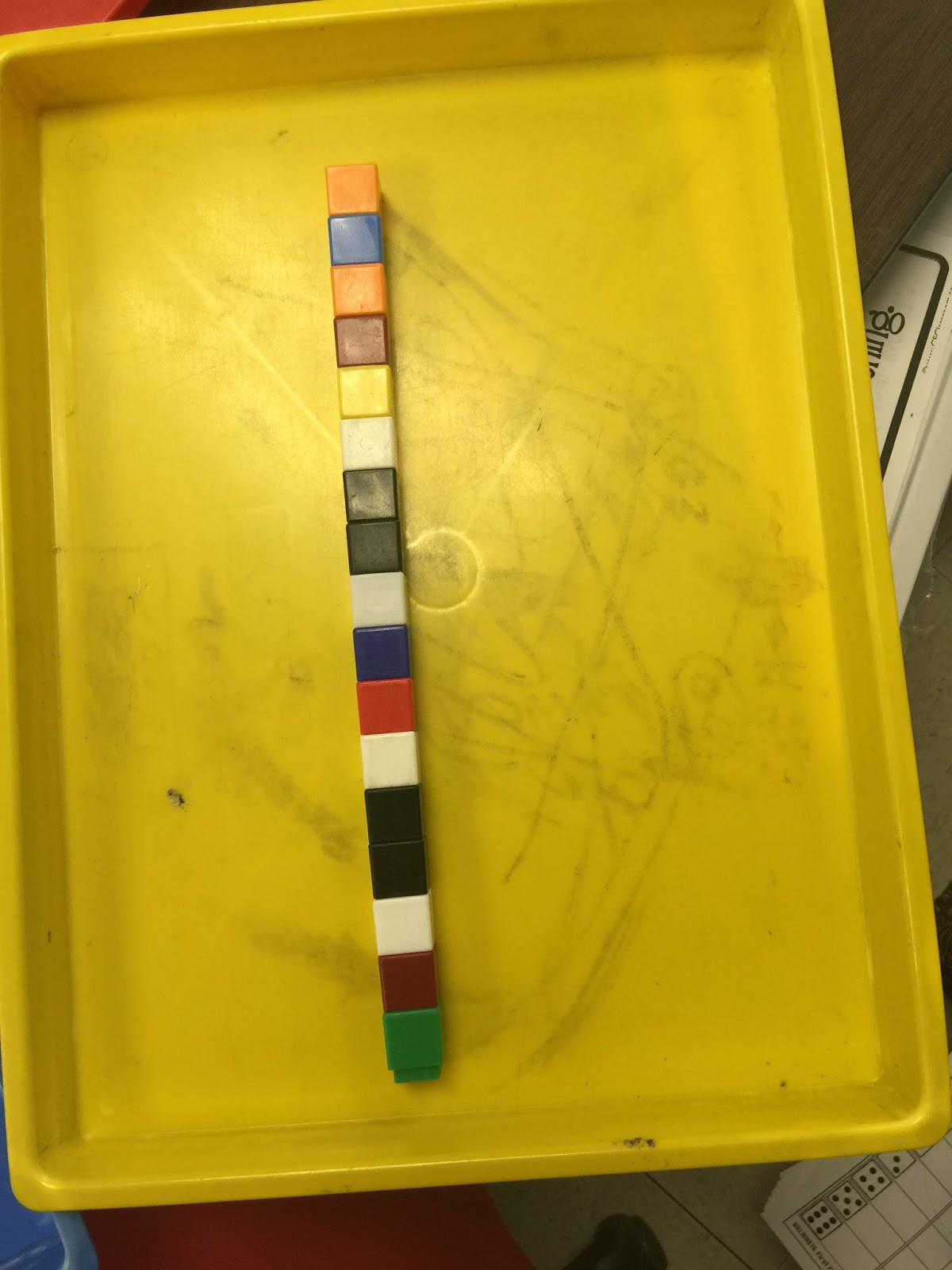
This tray just shows that a student started by making a train of 17 cubes to match the problem, which I always have posted.
This is what SMP #1 (make sense and persevere in solving problems) looks like with The Littles. During that first work session, some students couldn't really get started. They fumbled around a bit. Good job, Littles! You stuck with it! But we aren't just cheerleaders, we need to help them develop real strategies for getting on it. I showed them the tray and said, "How does this tray match the problem? Why did this person do this?" After some private think time, a little bit of partner sharing, and some questions for clarity, they told me that this makes sense because the problem says 17 acorns and these are 17 cubes, which are the acorns from the problem. I pressed on them until they articulated that if you weren't sure what to do, you could go back and look at the problem and see how it starts, and try to make your tray match the way the story starts.
And here we go! During the work session that day, they quickly got busy building their 17 acorns. Are you surprised that we are doing the exact same problem we already did? Pro tip:  don't introduce new problems every day. I like to share with them my favorite George Polya quote, "A problem isn't a problem if you can solve it in 24 hours". We are doing this problem again because that's what mathematicians do, they stick with their problem until they have learned everything there is to learn about it and from it. It's a good thing!

Strategies I want to promote
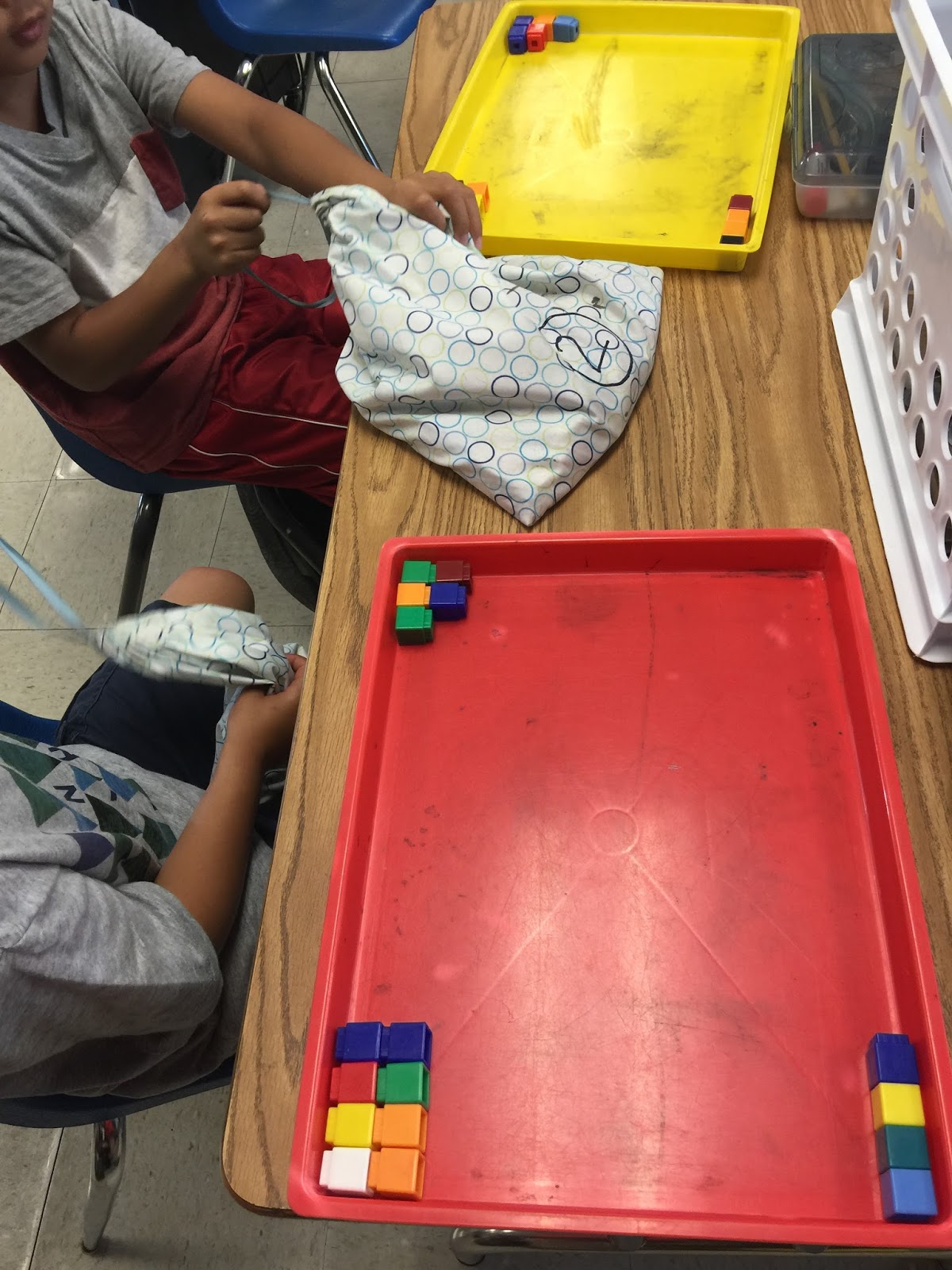
I followed the same process for the next two trays, just placing one in the middle of the learning circle and giving them some prompts to think about and partner talk about. Mostly, I just asked "What did this person do? How do you know it matches what is happening in the problem?"

And then this one, with the same prompts:

This one is different because it shows the squirrels. In Level B of this Problem of the Month, there are different kinds of squirrels and each type of squirrel can carry a different number of acorns back to their homes. Students will need to figure out how many trips the different types of squirrels will take to get the acorns back to their homes. In any case, managing the tools to represent both acorns and squirrels, in addition to the clever color coding to keep track of the different groups of squirrels, is a really helpful and powerful strategy for doing Level B, which we will be doing soon, so I wanted to make sure we put it out into our universe so we can call upon it.

And during the work session, after this quick inquiry mini lesson on these two different strategies for keeping track of feeding the squirrels in our problem, I saw the students experimenting.


 Various stages of making sense..... This little group had a hard time finding their error (they started with 16 acorns instead of 17 and thus ended with 3 acorns instead of 4) because they all made the same mistake and easily convinced each other that they were killing it. I made the executive decision to not address this wrong answer in real time, and instead held space for them to practice the strategy and practice their recordings.

 Another error....since this child was working alone and hadn't worked himself into a lather about how right he was, I found it easier to do the "match making"... This student was paired up with another student who used the same strategy, but who made 8 squirrels and 5 squirrels instead of 5 and 5. The dream is that when they talked it out, the other child would be convincing enough that this child will see how to fix their error without me being involved at all.
 I love this one, where he uses the tiles to be squirrels instead of the counters. I think little details like this show that he is really making sense of the strategy and making it his own, as opposed to just "mimicking" the strategy of using counters but not really understanding what he is representing. Kids have that kind of magical thinking sometimes, as though the math is in the chip instead of in the chip as representation. Recognizing that he can use any tool to show his squirrels is a little thing that feels very big in a primary classroom.

You nailed it, kid.


Now go find somebody to talk to!

Misconceptions to address
I saw wrong answers, but no real misconceptions. You can do everything "right" and still make mistakes. In life and in math, it turns out.


That was it for this session! Imperfectly perfect, in my eyes. So much movement in just this one attempt, and so many places still to go. That's how you know it's a good problem :) My "closing lesson" was on how we put away our trays and bags. Not life changing in terms of content, but lookit, these conversations have to happen. For my sanity.


Thursday, September 10, 2015

Second Problem Solving Workshop

Last Thursday was the first session (described here), and last Friday (the 8th day of school) we did the same problem with new numbers.  After doing 22-7, I noticed that most kids could get an answer, but there was very little understanding of place value (as tens and ones) and regrouping (in order to get more ones from a ten). Totally normal in the beginning of second grade, from my experience.

The workshop period follows the same structure of writing or reading workshop:  a mini lesson (10-15 minutes), a work period (115-20 minutes), and a close (5-7 minutes).  In this case, I wanted to address the way we build "bigger numbers", tool choices, and then sharing one strategy that a student had for regrouping. Then I would send them off to work on the exact same problem with even more complex numbers.

On the first day, I had seen many ways to make 22, but I didn't want to encourage all of them. There were ones I didn't love....here's one:
He was using the ten sticks like units, or tally marks, and needed 22 of them to make 22. It's not unusual, and he will figure this out (as of today, the 11th day of school, he was still doing this). I'm not sweating this (yet, haha) but I'm not offering it to other students, either.

So here's my mini lesson, to open up day two of our Problem Solving Workshop. I drew out the first tall train of 22 cubes, and the second 2 ten sticks with two extras way.  The last one, with two ten-cube trains and two extras, was added during the lesson, as were the marks cutting across the first tall train way.

I began by saying I saw lots of ways that people made 22...I said, I saw Mehdi make this tall train. (Added his name.)  When I asked if anybody else made it this way, we got lots of "me too" hand motions. I told them we would have to count them, to test his train, which we did chorally. When we verified that it was 22, I wrote it under the train. 

I went on to say that I saw some people making it this way, like Angel did. (Added his name.)  This also got lots of "me too" hand motions. (For "me too" we just do a thumb pointing to our chest, pinky stuck out in front of us, almost like a "hang ten" but pointing - often frantically - back at ourselves.) We counted it as 10-20-21-22, labeling as we went along and writing it under the train once we had verified it.

Now, my goal, always, is to get them talking and listening to each other. But it's with a nod to my sanity that I do a bit more of the heavy lifting in this area at the beginning of second grade than I am totally comfortable with. I can't tell you how many times I've started a lesson with "Jasmine did the most interesting thing yesterday, Jasmine, go ahead....tell us what you did" as a way of jogging her memory and handing off the discussion to a student, only to have the student launch into a totally unrelated, inconsequential account that usually starts with something like, "oh, first, I took all my blue cubes" (no you didn't) "and then I put 2 and 5 and 3 and then I..." (no you didn't) "I thought about what I should do and then I remembered that I had some red cubes" (no you didn't)..... enough already, let me handle this.

So Jasmine had built her 22 like this:
She had originally built it with the two ten sticks and the two extra cubes, but when I came back, she had built the second way, with the two trains of ten cubes and the two extra cubes.  When I asked her about this, she showed me how she took away the two, but then couldn't break the sticks:
Haha here she is trying to snap off a couple. So cute. During the mini lesson, I asked her to show us how she tried to snap some off, and at this point, I was able to say, can you now show us the NEW way you made the number 22? And she was good to know, she knew exactly what I was talking about and there we went.

So far, in the 10 minute lesson, we had addressed building the quantity three different ways, and we had shared a strategy for regrouping by using the cube trains rather than the base 10 ten sticks to build the number. (Notice that she didn't just regroup one ten, she redid ALL the tens. In direct instruction, we would no doubt instruct her to regroup one ten...virtually every second and third grader I've ever met does it the same way as Jasmine, before they make sense of just swapping out one.)

To close the mini lesson, we went back to Mehdi long train and I asked them to partner talk about if Mehdi's way was the same or different as Jasmine's way.  After we discussed it, I posed the question:  Can we make Mehdi's look like Jasmine's? Are there ten-trains inside this long train? (The said yes, there are)  How many do you think we can get? (two) Let's try. (We counted up to ten, marked it off, counted up to ten, marked off....and saw the two extras, just like Jasmine's. I invited them to think and build their numbers using "TENS" and gave them their new numbers.
We did the same problem and I gave them the numbers on the yellow post it note (34, 18). We read the problem together as "Ishika has 34 shells. She gives Jaiyana 18 shells. How many shells does she have left?"
 
And here's Mehdi....he moved immediately from the long train to the ten-cube trains to make 34.  Proving, once again, that sometimes a kid hears the exact next idea they needed to hear, and that's all they will need to move forward.

 And here's Bryan and Ahmillyion making tall towers. Proving, once again, that when a kid is not ready to hear it, they will take a great idea....and do absolutely nothing with it.  No big deal, I will be inviting them to think in tens for the next few months.  They will get there!

During this work session, Angel continued to build his numbers with base 10 ten sticks and single unifix cubes.  When I asked about how he was giving away 18 shells, he showed me how he gave away as many as he could, then he used his finger to count down the markings on the permanent ten stick. He held his finger over the counted off section and said, "If I could take this off, I would." I told him about Brandon, a third grade student I had many years ago, who had this same idea and he discovered that he could mark them off with an expo marker. We got one, and I showed him how it would be fine, that it rubs right off, and he went right to work.


Here he has crossed out all of one ten with a straight line, then x-ed out 8 more from the other permanent sticks. He counted the remaining cubes as 1-2-3-4-5-6 and 10 more is 16.

Lovely!  Now we have successfully concluded our SECOND problem solving workshop. Students are making sense of a simple give away problem in context, and we now have several ideas for building bigger numbers with tens, and two ideas for regrouping (marking off, or swapping out) when we don't have enough ones to give away.  I will point out, that there is no way I could give my second graders a worksheet with problems like 34-18 or even 22-7 during the first week of school. It is only because they are using this "direct model" method that they are able to do the math, while simultaneously making sense of place value, and developing their understanding of the attributes and functionality of the different tools.

The close on this second day was straightforward:  I saved Angel's idea for the opening of the next session, and we cleaned up and reconvened on the carpet to recollect what a responsible classroom sounds like and looks like when it is time to clean up. Hint: there is no yelling, running, or swinging math bags over our heads. *ahem*

Tuesday, September 8, 2015

First Problem Solving Workshop

We did our first problem solving workshop (PSW) on the 7th day of school. The first five days were introducing, exploring, and practicing with our tool bags.  Once that was settled, we were able to dive right in....by which I mean oh wait, wait another day because my schedule got rearranged at the last second. Oh, last minute changes, you vex me.

The PSW is my very favorite way to teach math when it comes to operations. The entire thing is based on my understanding of Carpenter/Franke's Children's Mathematics (Cognitively Guided Instruction).  If you teach any workshop, such as reading or writing workshop, you can use the same structure to create space for students to make sense of, and solve, problems.

The workshop structure includes a mini lesson, a work period (which may include a mid-workshop interruption), and a close.  The whole thing takes about 35 minutes - 45 minutes.  Shared below, as our very first PSW of the year, is a mini lesson (introducing a problem together, including reading and acting out) for 15 minutes; a work session for almost 20 minutes including clean up; and finally a quick close on the carpet, less than 5 minutes.

I have been doing this for many years, and I have always started with a "put together" problem. For the first time, I decided, at the last minute (oh, last minute changes, I LOVE you ;) to make the "separate" problem the first one. I am too pleased that I did!

This is all based on Carpenter's work, which I highly recommend that you read, start to finish.  Until then, the main points are 1) children can resolve math story problems without you and your snappy ideas; 2) they do this in totally predictable ways that they construct themselves; and 3) not all math story problems are created equally....some "problem types" are harder for children to access until they have built up a barrel of number sense and an understanding of part-whole relationships.  In reference to #1, if you start with the most accessible problem types, you won't have to do any underlining of key words or circling of numbers or any of that other stuff. And that's because of #2, which includes the information that virtually all students (when we stop pecking at their necks) begin all understanding with a strategy called "direct modeling".

In direct modeling, students will act out, with manipulatives, exactly what the story says, in the order it says it.  So if the math story says "I have 3 cookies. My mom gives me 2 mores cookies. How many cookies do I have now?" a child will read "I have 3 cookies" and place three blocks down. Then the child will read "my mom gives me 2 more cookies" and place two more blocks down.  When they read the question "how many cookies do I have now?" they count all the blocks they put down. (Worried that you have students who can't read this problem? Me too! I won't bore you with the results of my Fontas and Pinnell assessments I just completed, but please know that I have exactly 7 - out of 29 students - that would be considered on "beginning of 2nd grade level"....it's a real thing.)

Which is why, whenever we start a new problem type, we always start with a group reading and acting out of the problem. I like to use names of my students, and their real hobbies, to get us started. In this case, Ishika likes to collect rocks and sea shells, and her class buddy is Jaiyana.

The process is simple: I read it to them from the poster (with blanks....I say "hmmm" for the blank...Ishika has hmmm shells, like that).  We read it all together. I point out that not everyone is reading, so we read it chorally again. Except I have to interrupt us after the first sentence, because not everyone is reading. So we try again. Rinse and repeat UNTIL they GET it that EVERYBODY will participate, full stop. Once we've read it, I have them partner talk about what's happening in this problem. How would they describe what's happening?

This time they shared:  Ishika has shells. (What is she doing with the shells) She's giving shells away. (to whom?) She's giving them to Jaiyana.  (Who is "she" in the last sentence? Is it Ishika or Jaiyana?) It took some discussion, but they decided it was Ishika. Those referent pronouns with second language learners (21 of 29 are, for my class) can be tricky. It's worth talking about.

I gave them the black number pairs first, and taught them to populate the blanks with the numbers, in order. We did 8, 3 first and re-read it chorally as "Ishika has 8 shells. She gives Jaiyana 3 shells. How many shells does she have left?"  Ishika and Jaiyana come up and act it out with cubes. We prove the answer is 5. Then two other people play Ishika and Jaiyana and we did it again for the numbers 7, 2. Two other actors did 9, 3. And a final pair of actors did 11, 2. They would have gone on, but really, it was enough.
As you can see in the picture above, teaching this system of reading the problem with number pairs is extremely helpful as you try to differentiate in your classroom. For the student who finishes in seconds, you can quickly write two more difficult numbers on a post-it and tell them, "These are your new numbers" and they get right to work on it. Likewise, when you come across a Little One who just can't get started, who can't get any traction, you can quickly jot down two smaller, more accessible numbers and say "Try it again with these". Since you taught them how to populate the problem with any two numbers, they are good to go.

When I send them off to the do the problem on their trays with their bag of math tools, I sent them off with the red numbers, 22, 7.  We read it altogether one last time, and then we go to work. Super important: I always send them off with numbers that are just out of their reach....I want it to be a problem they haven't memorized as a basic fact, so that they will rely on the direct modeling intuition to solve the problem. In this case, I also want them to struggle with dealing with the notion of needing to regroup....If they build 22 with two ten-sticks and two units, they are going to be confronting some big math ideas right away. Yummy, I say!

 My job during the work period is to move through the room gathering information, and to do what I call "match making"....finding pairs of students who should talk to each other. It's always the same at first, "Teacher the answer is 9" and that's immediately followed by another breathless student saying "Teacher the answer is 14" at which point somebody will say "No teacher isn't the answer 15?" and I will say, simply, "The three of you need to take your trays to the carpet and explain how you did the problem....do you agree with each other? Is there a way to prove which one of you has the right answer? Do any of you have the right answer?" And so on, until just about everybody is partnered up and discussing the mathematics.
The other job I have is to gather up which strategies they are using. Are there any that should be shared and promoted because they are efficient, flexible, or mathematically important? Are there any that make me want to cry? haha Not even kidding about that one.
This is a really common way of building the 22 in the beginning of second grade. This child is not yet thinking in tens and units, just counting all out by ones.
 This child is also counting all out by ones. The ten sticks are not being thought of as "groups of ten", he is counting each one as "one" and needs 22 of them to make 22. This is less alarming than you might think....lots of students interpret this tool as a "tally mark" almost, rather than as a group of ten. They will make sense of it shortly. In the tray next to him, some enterprising lovely has made 22 as two ten sticks and two units. Thank you, sweet one, this will be very helpful, very soon.

Also very common, is the really long train method of making any number. This is a version of thinking in units, rather than thinking in tens and extras.

That's it! Isn't it lovely? There's no real resolution at the end of these first session, but we have LOTS of information about how our kiddos are making sense of quantity and subtraction, and we have LOTS of great conversations and proof.

At the end of this first session, we clean up and meet back down on the carpet. So much math to share! But I hold it until the next day, when I can craft a sensible mini lesson out of all that math to start our next work session. For today, we close with a quick debrief on the way this works:  We solve our problem, and we get an answer....BUT....we are not "done" until we have talked about what we did with somebody else. Do we understand them? Do they understand us? Are we in agreement? Here is where we can make the point that talking about our math is what let's us test and prove our ideas.  Here is well I will also, gently, suggest that you can talk to each other without first asking me...find somebody to work with, you won't be sorry my Littles!